Schacht Ladybug Review: Triple Drive, Maple, Made in the USA
The $1,047 Schacht Ladybug pairs three drive modes (double drive, Scotch, Irish tension) with four ratios in hard maple, built to order in Boulder, Colorado.
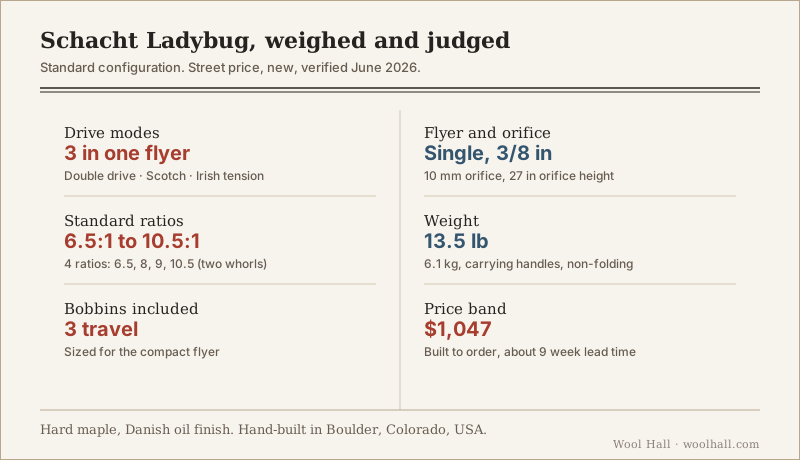
The Schacht Ladybug is a castle-style wheel built from hard maple in Boulder, Colorado. At $1,047 it ships with three drive modes (double drive, Scotch tension, Irish tension) in one flyer assembly, four ratios from 6.5:1 to 10.5:1, and a hand-painted ladybug design unique to each wheel. Lead time is nine weeks. It’s sold at authorized US dealers including The Woolery, Paradise Fibers, and Halcyon Yarn; prices verified June 2026.
| Spec | Value |
|---|---|
| Style | Castle |
| Drive modes | Double drive, Scotch tension, Irish tension |
| Included ratios | 6.5:1, 8:1, 9:1, 10.5:1 |
| Wheel diameter | 16 in (40.6 cm) |
| Orifice | 3/8 in (10 mm) |
| Orifice height | 27 in (69.5 cm) |
| Bobbins included | 3 travel bobbins |
| Treadles | Double, non-folding |
| Weight | 13.5 lb (6.1 kg) |
| Height | 29 in |
| Wood | Hard maple and maple plywood |
| Finish | Danish oil |
| Country | Boulder, Colorado, USA |
| Price | $1,047 |
What kind of spinning wheel is the Schacht Ladybug?
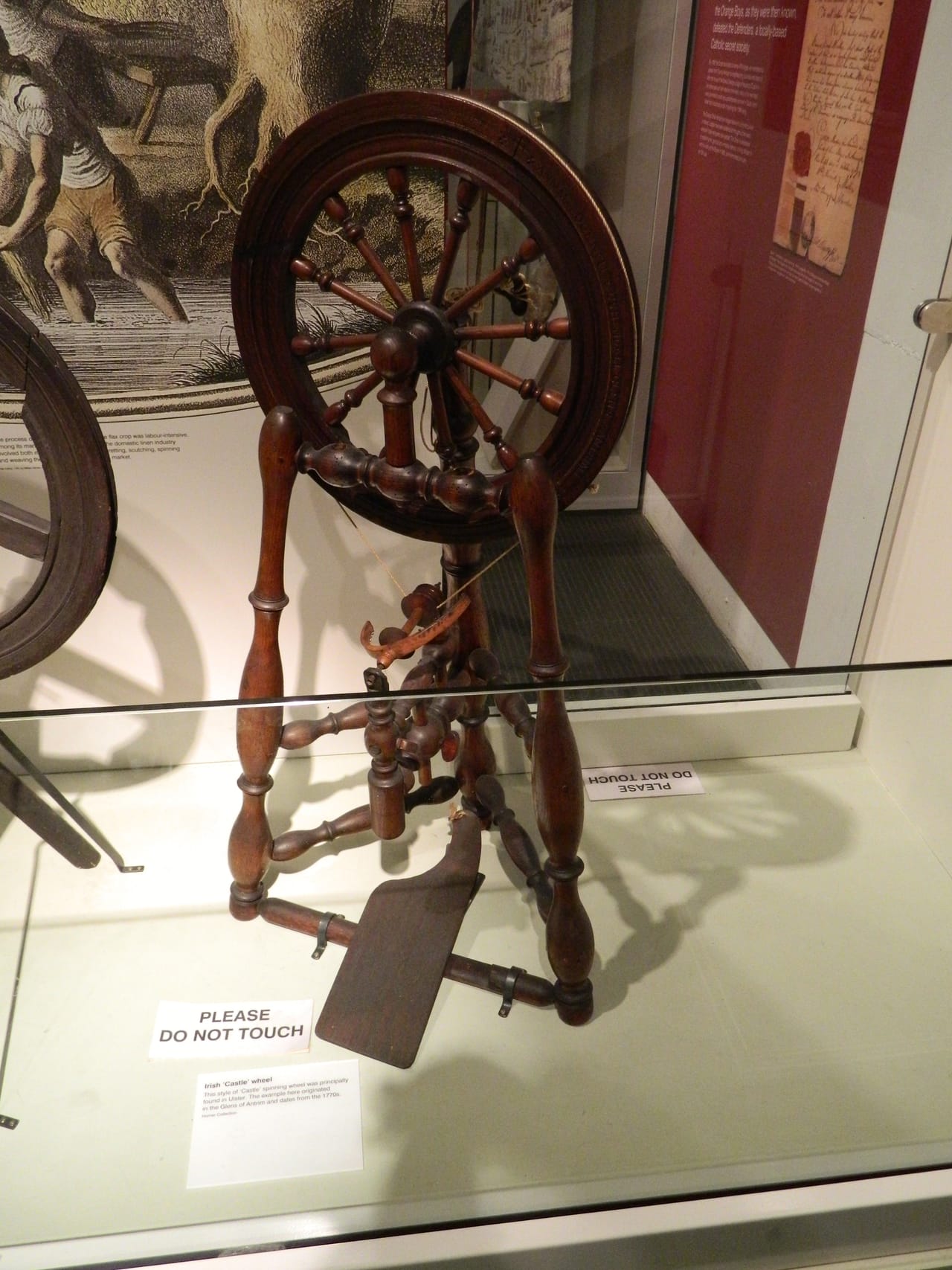
The Ladybug is a castle-style wheel, meaning the flyer and bobbin assembly sits directly above the drive wheel on a vertical frame. That stacks the footprint into a narrow column rather than spreading it horizontally the way a Saxony design does. You can park the Ladybug in less floor space than a Saxony wheel at a comparable wheel diameter, and the compact frame helps keep the total weight to 13.5 pounds.
The wheel itself is 16 inches across, smaller than the 22-inch wheel on the Ashford Traditional. A smaller drive wheel means more treadle revolutions per yard of yarn, but the difference is minor at the ratios the Ladybug runs. The practical effect is a quieter, smoother motion at lower ratios, which many spinners find easier on the joints during long sessions.
The frame is hard maple and maple plywood with a Danish oil finish. Hard maple sits near the top of the Janka hardness scale for North American hardwoods. It resists dents and wear at hardware contact points better than the silver beech Ashford uses or the softer pines found on budget wheels. Danish oil soaks into the grain rather than building a surface film, so scratches and dents can be touched up without stripping and refinishing.
Each Ladybug ships with a hand-painted ladybug illustration on the frame. Schacht paints each one individually, so no two are identical. It is a small detail, but it comes up consistently in owner accounts as the thing that made the wheel feel personal rather than interchangeable.
How does the Ladybug’s three-mode drive system work?
One flyer assembly runs all three modes (double drive, Scotch tension, and Irish tension) with no hardware swap; you simply reroute the drive band and adjust the tension. Most wheels in the Ladybug’s price range give you one drive mode. The Ashford Kiwi 3, at $248 less, runs Scotch tension only.
Double drive routes the drive band in a figure-eight so it contacts both the flyer whorl and the bobbin whorl. Both spin simultaneously. Take-up is smooth and self-regulating because the differential speed between the two pulls yarn onto the bobbin as you draft. Double drive is the classic mode for worsted and woolen spinning at consistent take-up and suits a wide range of fiber types.
Scotch tension (single drive, flyer-led) drives the flyer whorl only. A separate spring-loaded brake band wraps around the bobbin. You adjust take-up by tightening or loosening that brake. This is the most common entry mode on wheels because it is tolerant and easy to learn: more braking for faster take-up, less for slower. It handles bouncy or chunky fiber well.
Irish tension (single drive, bobbin-led, sometimes called bobbin-lead) reverses the arrangement: the drive band powers the bobbin whorl and the flyer is braked. The bobbin spins faster than the flyer, pulling yarn onto itself as you feed it. Take-up is higher per treadle revolution, which is exactly what you want for bulky singles, art yarn, and core spinning. Most spinners reach for Irish tension only on specific projects, but having it on the same wheel means not buying a second specialized machine.
Switching between modes takes about two minutes: move the drive band into a different groove, adjust the tension, spin.
What drive ratios does the Ladybug include, and what can you spin?
Two whorl pieces come in the box: Medium Speed and Fast Speed. Each piece has two grooves of different diameters, giving two ratios per whorl. Medium delivers 6.5:1 and 8:1, Fast delivers 9:1 and 10.5:1. Those four ratios cover bulky to light worsted weight comfortably.
At 6.5:1, one treadle press turns the flyer 6.5 times. At a relaxed treadle pace that is enough to draft thick singles from batts without twist outrunning your hands. At 10.5:1 with a brisk treadle you can spin consistent fingering weight without feeling rushed.
Three additional whorl pairs are sold separately. The Slow Speed whorl (4.7:1, 5.5:1) takes the Ladybug into art yarn territory, where you need the wheel to push twist slowly so you can embed objects or wrap bulky pre-spun fiber. The High Speed (11.5:1, 14:1) and Super High Speed (12:1, 14.5:1) whorls open up finer thread spinning for those working with Merino lace or single-ply gossamer. If very fine lace yarn is your primary goal from the start, it is worth comparing the Ashford Traditional, which reaches 17:1 in its standard double-drive configuration without any optional parts.
How does the Ladybug compare to similarly priced Ashford wheels?
The two closest comparisons are the Ashford Kiwi 3 at $799 and the Ashford Traditional at $999 (both lacquered versions; prices verified June 2026 at authorized dealers).
| Feature | Kiwi 3 | Traditional (SD) | Ladybug |
|---|---|---|---|
| Country | New Zealand | New Zealand | USA |
| Style | Castle | Saxony | Castle |
| Drive modes | Scotch tension | Scotch tension | Double drive, Scotch tension, Irish tension |
| Highest standard ratio | 9.5:1 | 17:1 | 10.5:1 |
| Wheel diameter | 17.7 in | 22 in | 16 in |
| Bobbins included | 3 (130 g each) | 4 (100 g each) | 3 travel bobbins |
| Treadles fold | Yes | No | No |
| Weight | 12 lb | 17.5 lb | 13.5 lb |
| Price | $799 | $999 | $1,047 |
The Kiwi 3 is the value option: lighter, foldable, $248 less. But Scotch tension only means you give up double drive and Irish tension entirely. Spinners who decide later they want those modes will either buy a second wheel or pay to retrofit.
The Traditional costs $48 less than the Ladybug and reaches 17:1 on the single-drive model, a ratio the Ladybug can only approach with an optional Super High whorl. If ratio range matters more than drive-mode variety, the Traditional is competitive. If drive-mode versatility matters more, the Ladybug pulls ahead.
Schacht has been building weaving and spinning equipment in Boulder since 1969, and the made-in-USA factor means the company handles parts and service directly from that same facility. Lead time of nine weeks reflects actual build time, not warehouse delays. That same nine-week wait is worth knowing before you order.
What does the Ladybug come with, and what are the main upgrade options?
The standard package includes the wheel, double treadle, three travel bobbins, the Medium Speed whorl, the Fast Speed whorl, the drive band, and an orifice hook. The wheel arrives assembled or near-assembled; setup is minimal.
The bobbins are sized for the Ladybug’s compact flyer. Schacht sells additional travel bobbins separately, and most spinners pick up a half-dozen extras so they can work across multiple projects without stopping to wind off.
Upgrade options from Schacht worth knowing about:
- Jumbo flyer and bobbin for thick and bulky singles, extra-wide orifice
- Lazy kate for plying from filled bobbins (a stand-alone floor unit)
- Bulky plyer flyer if you plan to ply thick handspun regularly
- Slow, High, and Super High Speed whorls as described above
A Start Spinning Bundle with an introductory book and fiber runs about $1,140 at most dealers, saving roughly $90 off buying those items separately. Worth considering if you are equipping from scratch.
Is the Schacht Ladybug the right wheel for you?
It earns its price if you know you want more than Scotch tension. The triple drive system is the main argument: for what most spinners pay in the $1,000 range elsewhere, the Ladybug delivers genuine drive-mode versatility rather than locking you into one technique.
Think twice if very fine lace is your primary goal. The Ladybug does not reach 17:1 without an optional whorl, and the Ashford Traditional gets there standard for $48 less.
Think twice also if you expected a folding travel wheel. The Ladybug has integrated carrying handles and at 13.5 pounds is manageable, but it does not collapse the way the Kiwi 3 does. If a wheel that packs into a car boot for guild nights is what you need, the Schacht Wolf Pup and the Kiwi 3 are better fits.
If you are still in the early stages of deciding whether wheel spinning is worth the investment at all, starting with a drop spindle costs under $30 and teaches the core drafting skills that transfer directly to any wheel.
For a spinner who knows they want a versatile, durable wheel built by a company with a direct parts and service chain, the Ladybug is one of the cleaner decisions in its price range. Nine weeks is a real wait. The wheel that arrives is worth it.