Best Spinning Wheels: Entry, Mid-Range, and E-Spinner Picks
The Ashford Kiwi 3 is the best beginner wheel under $500, the Schacht Ladybug wins mid-range, and the EEW 6 leads e-spinners. Full comparison inside.
The best spinning wheel for most new spinners is the Ashford Kiwi 3. It costs $400 to $550 new (less used), handles every fiber and yarn weight, and has more tutorial content, Ravelry posts, and beginner guidance attached to it than any other wheel in the price range. Start there. Upgrade when you hit a specific limit.
At the mid-range, the Schacht Ladybug is the standard recommendation: triple drive, domestic construction, long-term parts support. The EEW 6 leads the e-spinner category for spinners who want portability or live where a treadle wheel is impractical. These three wheels, at three price points, cover nearly every spinning need.
What makes a spinning wheel worth buying?
A spinning wheel is worth buying when you want continuous spinning speed: it does one thing a drop spindle cannot, letting you spin without stopping to wind on. The treadle drives the flyer, which twists fiber into yarn and winds it onto the bobbin simultaneously. A practiced spinner on a good wheel produces finished yarn at 5 to 20 times the speed of a drop spindle.
The trade is size and cost. A floor treadle wheel takes up roughly 3 by 4 feet of space and costs $400 to $1,500 new. The wheel itself is not complicated mechanically, but setting up the drive system, tensioning the scotch tension or double drive correctly, and learning to draft consistently while treadling takes weeks of practice. For spinners who want to produce meaningful quantities of yarn, the investment pays off quickly.
The comparison table
All prices verified June 2026. Drive system abbreviations: ST = scotch tension, DD = double drive, IT = Irish tension.
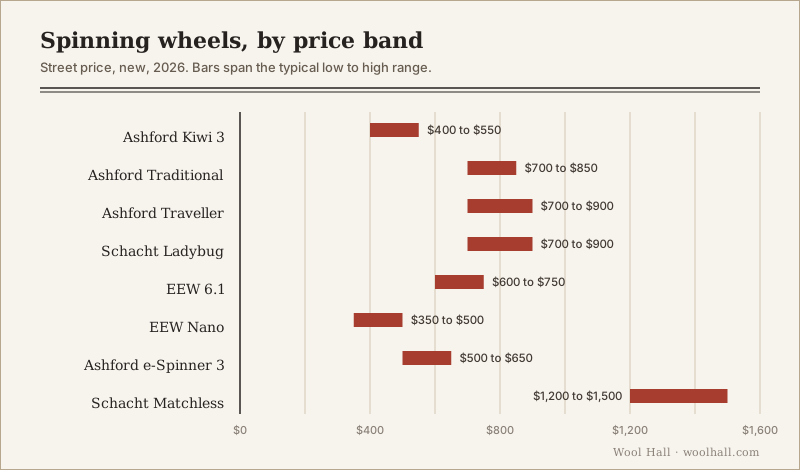
| Wheel | Type | Drive | Ratio range | Weight | New price |
|---|---|---|---|---|---|
| Ashford Kiwi 3 | Treadle (castle) | ST | 6:1–17:1 | 10 lb | $400–$550 |
| Ashford Traditional | Treadle (Saxony) | ST or DD | 5:1–17:1 | 17 lb | $700–$850 |
| Ashford Traveller | Treadle (castle) | ST or DD | 5:1–19:1 | 16 lb | $700–$900 |
| Schacht Ladybug | Treadle (castle) | ST / DD / IT | 6:1–18:1 | 15 lb | $700–$900 |
| EEW 6.1 | E-spinner | ST (motor) | adjustable | 4.4 lb | $600–$750 |
| EEW Nano | E-spinner | ST (motor) | adjustable | 1.3 lb | $350–$500 |
| Ashford e-Spinner 3 | E-spinner | ST (motor) | adjustable | 4.4 lb | $500–$650 |
| Schacht Matchless | Treadle (castle) | ST or DD | 6:1–29:1 | 24 lb | $1,200–$1,500 |
Which spinning wheel should you buy at each price?
The Ashford Kiwi 3 is the entry pick, the Schacht Ladybug the mid-range pick, and the EEW 6.1 the e-spinner pick. Above all of them sit heirloom and specialty makers, Alden Amos, a vintage Macomber, at $2,000 and up: collector and production-specialist territory, not most spinners’ first wheel. Here is the case for each of the three picks, plus the best Saxony-style wheel.
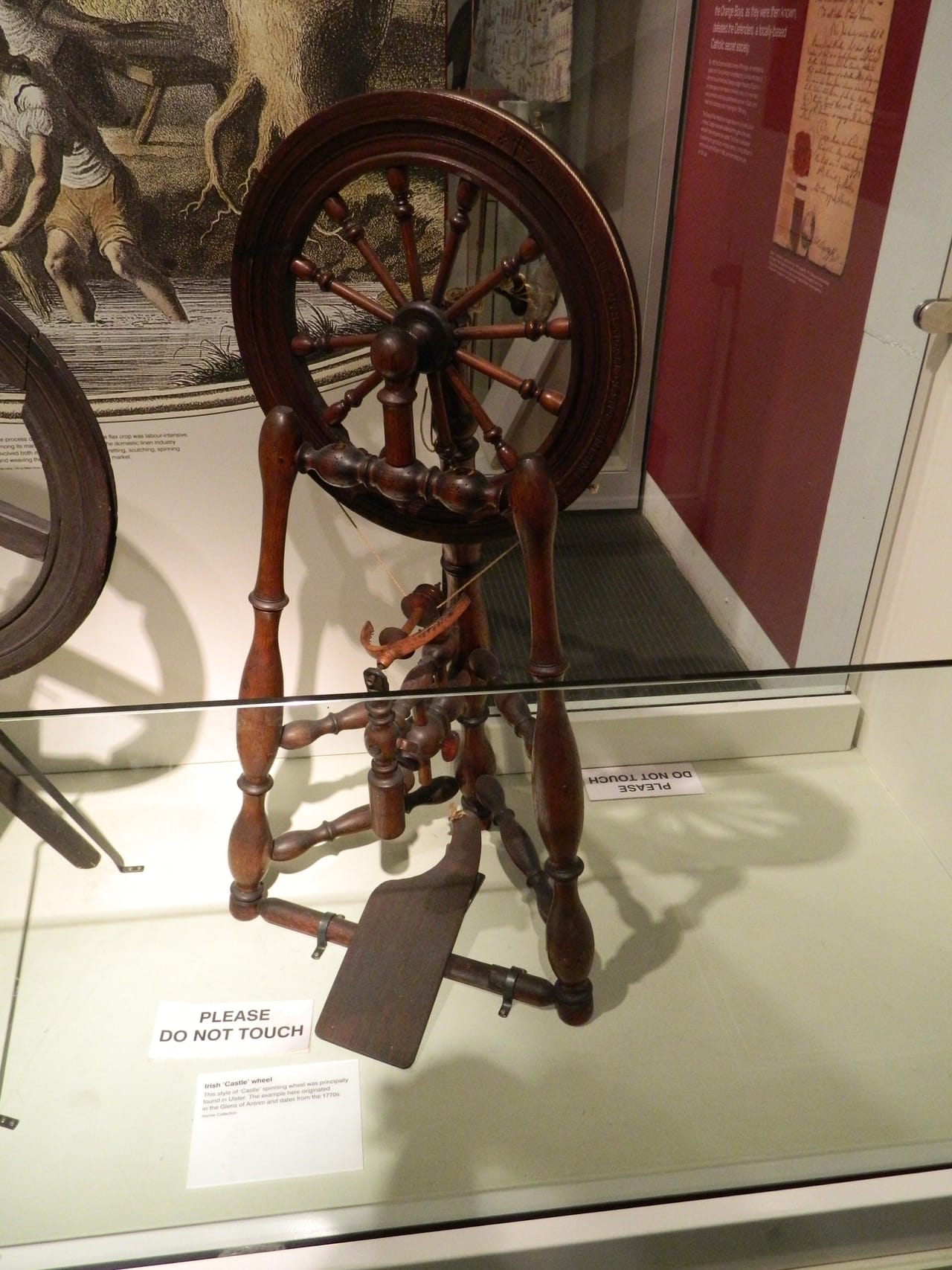
Best entry wheel: Ashford Kiwi 3. The Kiwi 3 is the right first wheel for most beginners. The scotch tension system is the most intuitive for new spinners because the take-up knob gives you a single point of adjustment: turn it one way for more uptake, the other way for less. The wheel ships mostly assembled and comes with two flyers for different yarn weights. The Ashford tutorial archive and the size of the Kiwi 3 community on Ravelry mean that every beginner question has been asked and answered. See the full Ashford Kiwi 3 review for setup notes and what long-term owners report.
It isn’t the wheel for everything. High-ratio production spinning for fine yarn is where it shows its ceiling: the Schacht Matchless spins fine singles noticeably faster, and a wheel with a smaller orifice and a higher top ratio has the edge on true laceweight. For most weavers spinning their own yarn supply rather than production quantities, none of that matters. The Kiwi 3 handles the job for years.
Best traditional/Saxony-style: Ashford Traditional. The Ashford Traditional has been in continuous production since the 1960s, which is the story: it is still the same wheel, still works, and Ashford still supports it with parts. The Saxony form (horizontal drive wheel, long treadle on a low frame) is slower to set up and less space-efficient than a castle wheel but has a distinct feel that many spinners prefer, especially for longwool breeds. See the Ashford Traditional review and the Kiwi 3 vs Traditional comparison.
Best mid-range: Schacht Ladybug. The Ladybug is a double-treadle castle wheel with a triple-drive configuration option: you can run it as scotch tension, double drive, or Irish tension (bobbin-led). That flexibility makes it a wheel you grow into over years rather than outgrow. Colorado maple construction, Schacht’s customer service in Boulder, and a ratio range that covers fine laceweight to chunky, expandable further with additional whorls, make it the standard mid-range recommendation for spinners moving up from an entry wheel. The full Schacht Ladybug review covers the triple-drive configuration in detail.
Best e-spinner: EEW 6.1. The EEW 6.1 (Electric Eel Wheel) is the most reviewed and trusted e-spinner in the current market. A brushless DC motor drives the flyer assembly from a compact frame that weighs 2 kg and fits in a carry-on. It handles the same fibers as any treadle wheel, accepts Ashford and Schacht flyer accessories, and runs on a rechargeable battery. For spinners who need portability, live in apartments, or want to spin without the treadle motion (a meaningful consideration for spinners with knee or hip issues), it is the right answer. The EEW 6 review and the e-spinner vs treadle wheel comparison both cover the decision.
When should you upgrade from an entry wheel?
Most spinners outgrow an entry wheel for one of three specific reasons, not from time spent at the wheel. The first is the ratio ceiling: entry wheels typically top out around 17 to 18:1, and fine yarn wants 20 to 29:1 to get enough twist in fast enough. The second is orifice size: a standard orifice fights you on thick art yarn, the kind of chunky, textured singles that need room to pass through. The third is drive-system preference: you’ve tried double drive on a friend’s wheel or at a guild meeting and want more of it than a scotch-tension wheel offers.
If none of those three apply, there’s no reason to upgrade. Plenty of spinners weave and spin for years on a Kiwi 3 or a used Ashford Traditional without ever hitting a wall. The upgrade is justified by a specific bottleneck you can name, not by how long you’ve owned the wheel.
Which drive system should you choose?
Beginners should choose scotch tension, the most forgiving system to set up and adjust. The drive system is the most important variable after price. A full explanation is in the spinning wheel anatomy guide; the short version for buying purposes:
Scotch tension is the beginner-friendly default. The take-up force (how hard the wheel pulls spun yarn onto the bobbin) is controlled by a single brake band with a spring and adjustment knob. Intuitive to set, easy to adjust mid-project. Almost all entry wheels use it. The Kiwi 3, Joy 2, and EEW 6 all use scotch tension.
Double drive uses two bands and no separate brake. The difference in whorl sizes creates the take-up force. At high speeds, double drive produces very even twist because the bobbin and flyer are mechanically linked. More complex to tension initially; preferred by many experienced production spinners.
Irish tension (bobbin-led) drives the bobbin and brakes the flyer. This reverses the normal take-up direction and is used for bulky art yarns where strong take-up is needed. Less common; the Schacht Ladybug and Matchless are among the few wheels that offer it.
Most weavers who spin for their own yarn supply start on scotch tension and never need to change. Spinners who want to explore all three should look at the Ladybug or the Matchless, both of which support all three configurations with whorl and band changes.
Should you buy an e-spinner or a treadle wheel?
Choose an e-spinner only for portability, silence, or a physical limitation that makes treadling hard; otherwise a treadle wheel gives more for the money. E-spinners are not cheaper than treadle wheels. The EEW 6 at $600 to $750 costs more than a Kiwi 3. The value proposition is portability, silence, and no treadling requirement, not price.
The three reasons to choose an e-spinner over a treadle wheel:
- You need to spin in a small apartment where a treadle wheel’s noise or footprint is a problem.
- You travel with spinning and need carry-on compatibility.
- You have a physical limitation that makes sustained treadling painful or impossible.
Travel doesn’t automatically mean e-spinner, though. The Ashford Joy 2 is a genuine travel treadle wheel: it folds flat to about 4 inches, packs in a bag, and weighs 10 to 12 pounds, light enough for checked luggage if not quite a carry-on. The Ashford Traveller breaks down for transport too, though it’s bulkier than the Joy. If you want the treadling ritual and can live with checked-baggage weight instead of carry-on weight, a folding treadle wheel is still on the table.
If none of those apply, a treadle wheel gives more for the same money: higher top ratio, better resale value, and the tactile ritual that many spinners consider the point of spinning. For the full trade-off analysis, see the e-spinner vs treadle wheel guide.
Which fibers can a spinning wheel handle?
Every wheel in this guide handles the full fiber range: commercial top (merino, BFL, alpaca, silk), hand-carded batts, rolags, locks, raw washed fleece, and processed longwool. Cotton spins too, though it takes practice and a fine ratio that most entry wheels don’t reach comfortably. Three things change by fiber: take-up tension (lighter for fine fibers, heavier for thick), ratio (higher for fine, lower for thick), and flyer choice, the standard flyer handles most fibers at most yarn weights, while the jumbo flyer is needed for thick art yarn (bulky singles, thick-and-thin, coils). Ashford and Schacht both sell jumbo flyers as accessories for most of their wheel lines.
Fiber preparation determines yarn character before the wheel sees the fiber at all. Combed top produces worsted-spun yarn (dense, smooth, lustrous); carded batts produce woolen-spun yarn (lofty, airy, soft). The fiber prep guide covers which preparation produces which yarn character.
Where should you buy a spinning wheel?
Buy current-production wheels from dedicated weaving and spinning retailers: The Woolery, Paradise Fibers, WEBS (yarn.com), and Ashford and Schacht directly. Used wheels appear regularly on Ravelry’s Wheels for Sale group, Facebook Marketplace, and guild sales. A used Kiwi 3 in good condition typically sells for $150 to $300, which is the right starting point for spinners who are not yet certain they will spin long-term. An older secondhand Ashford Joy works just as well at that budget and teaches the same fundamentals.