Spinning Wheel Anatomy: Every Part Named and What It Does
Drive wheel, flyer, bobbin, whorl, scotch tension, Irish tension: every spinning wheel part named with the drive-system decoder every wheel buyer needs.
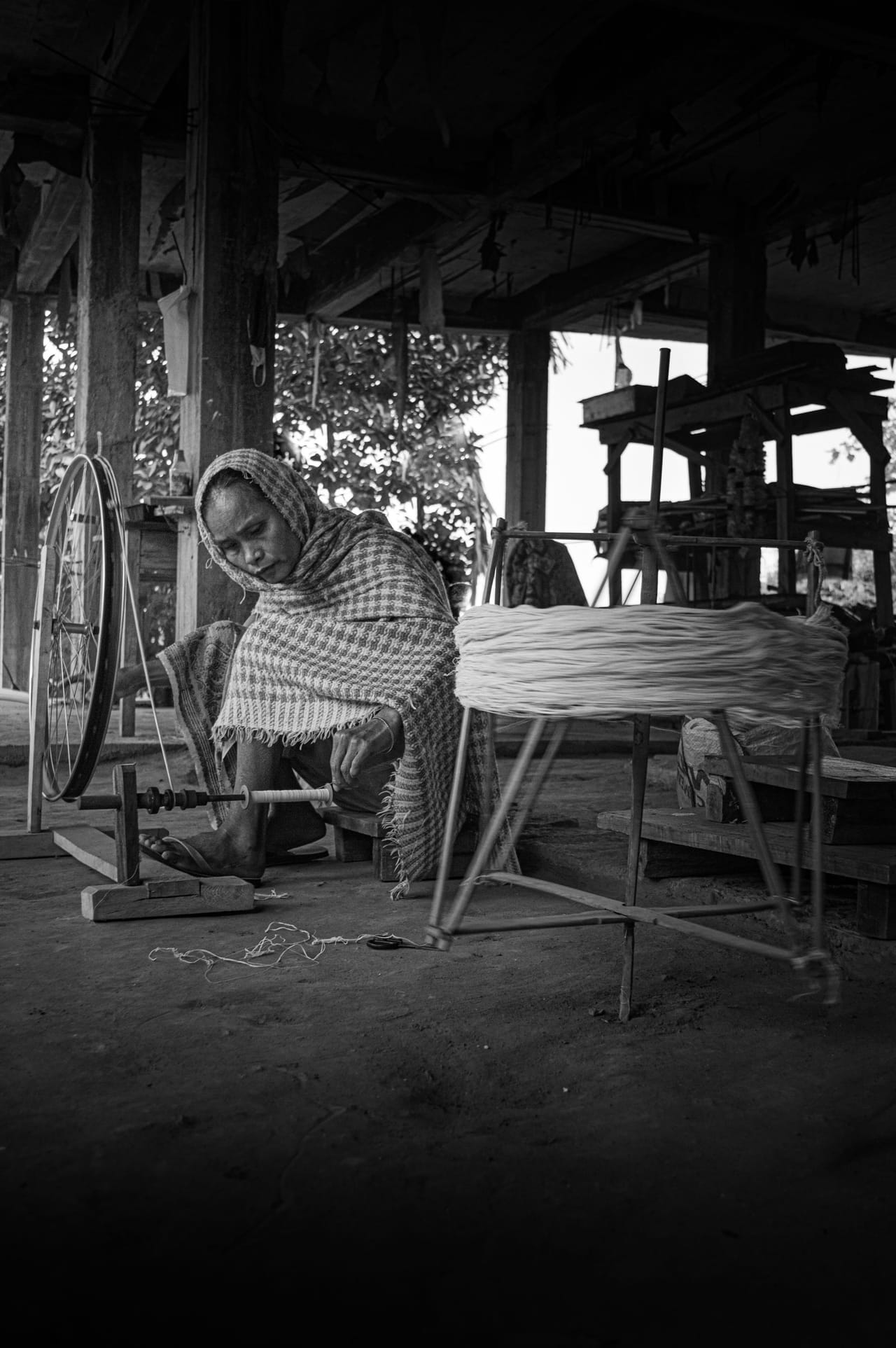
A spinning wheel does two jobs: it twists fiber into yarn and winds that yarn onto a bobbin. The flyer inserts twist, the bobbin stores it, the drive system links your feet to both, and the tension system balances how fast twist goes in against how fast yarn winds on. Every part serves one of those tasks.
Understanding the parts by function, not just by name, makes buying and adjusting a wheel much clearer. Here is how every part fits together.
What are the main structural parts of a spinning wheel?
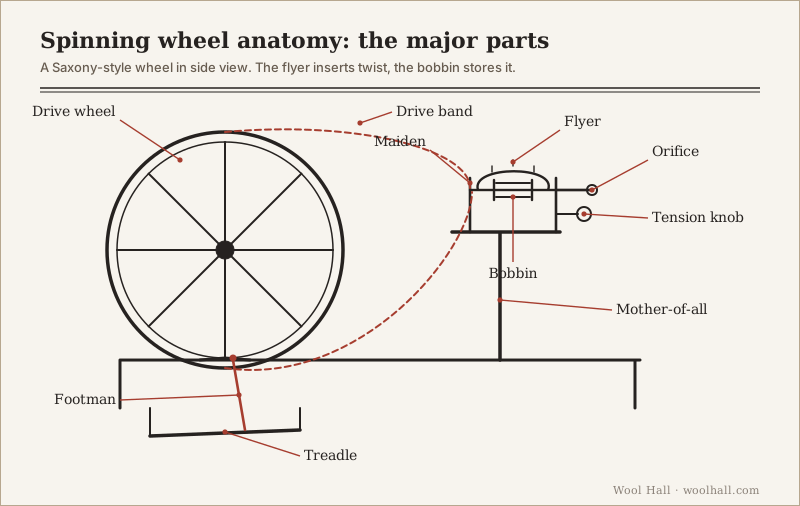
The frame has four structural parts: the drive wheel, the mother-of-all, the maidens, and the treadle with its footman. Together they provide momentum and carry the spinning assembly.
The drive wheel is the large wooden wheel that provides momentum. The spinner’s foot on the treadle turns the drive wheel, and the drive wheel turns everything else via the drive band. Drive wheels range from about 18 inches in diameter (compact travel wheels) to 28 inches or more on Saxony-style wheels. A larger drive wheel turns the flyer faster per treadle stroke, which matters for calculating drive ratio.
The mother-of-all is the horizontal bar that supports the flyer assembly. It sits on a vertical post and can usually be angled or slid forward and back, both to tension the drive band and to keep the flyer properly aligned over the drive wheel. On Ashford wheels the mother-of-all has a distinctive flat profile; on Schacht wheels it is often a round rod. When the drive band goes slack, moving the mother-of-all forward (away from the drive wheel) re-tensions it.
The maidens are the two upright posts that hold the flyer shaft on its bearings. Front maiden and rear maiden. The front maiden is where the scotch tension brake band typically anchors. Maidens must hold the flyer perfectly level; if a wheel is spinning unevenly or the bobbin wobbles, the maiden alignment is the first thing to check.
The treadle and footman provide foot-powered rotation. The footman is a connecting rod: one end attaches to the treadle, the other to a crank on the drive axle. Each time your foot presses down, the footman pulls the crank through 180 degrees of rotation. Single-treadle wheels treadle with one foot; double-treadle wheels have two footmen on cranks offset 180 degrees, so you can treadle alternately like bicycle pedals. Double treadle reduces fatigue in long spinning sessions. The Ashford Kiwi 3 ships with a single treadle and is convertible to double; the Schacht Ladybug ships double-treadle as standard, as do production wheels like the Schacht Matchless and the Ashford Traveller in its double-treadle configuration.
What is the flyer-bobbin assembly?
The flyer-bobbin assembly is where spinning actually happens, and it consists of three interdependent parts: the flyer, the orifice, and the bobbin. The flyer inserts twist while the bobbin stores the finished yarn.
The flyer is the U-shaped arm that rotates around the bobbin. Its two arms have hooks or yarn guides set at intervals. Fiber enters through the orifice (a hollow tube at the front tip of the flyer), travels along one arm of the flyer and catches on a hook, then wraps onto the bobbin. You move the yarn from hook to hook as the bobbin fills to distribute yarn evenly. Some wheels use sliding hooks or automatic yarn guides instead of fixed hooks.
The orifice is the hollow tube at the front of the flyer through which fiber enters the assembly. Standard orifice diameter is 6 to 9 mm, which handles most spinning. Wheels designed for art yarn, thick singles, or chunky plied yarn offer larger orifices (10 to 18 mm). The orifice size is the one spec that cannot be adjusted after purchase, which is why art yarn spinners check it carefully. An orifice that is too small for thick yarn will jam.
The bobbin sits inside the flyer, on the same shaft, and rotates at a slightly different speed. The differential between flyer speed and bobbin speed is what winds yarn on. If both rotated at exactly the same speed, yarn would twist but not advance onto the bobbin. The bobbin has a whorl (a small pulley) at its base that the drive band or brake band engages.
How do spinning wheel drive systems work?
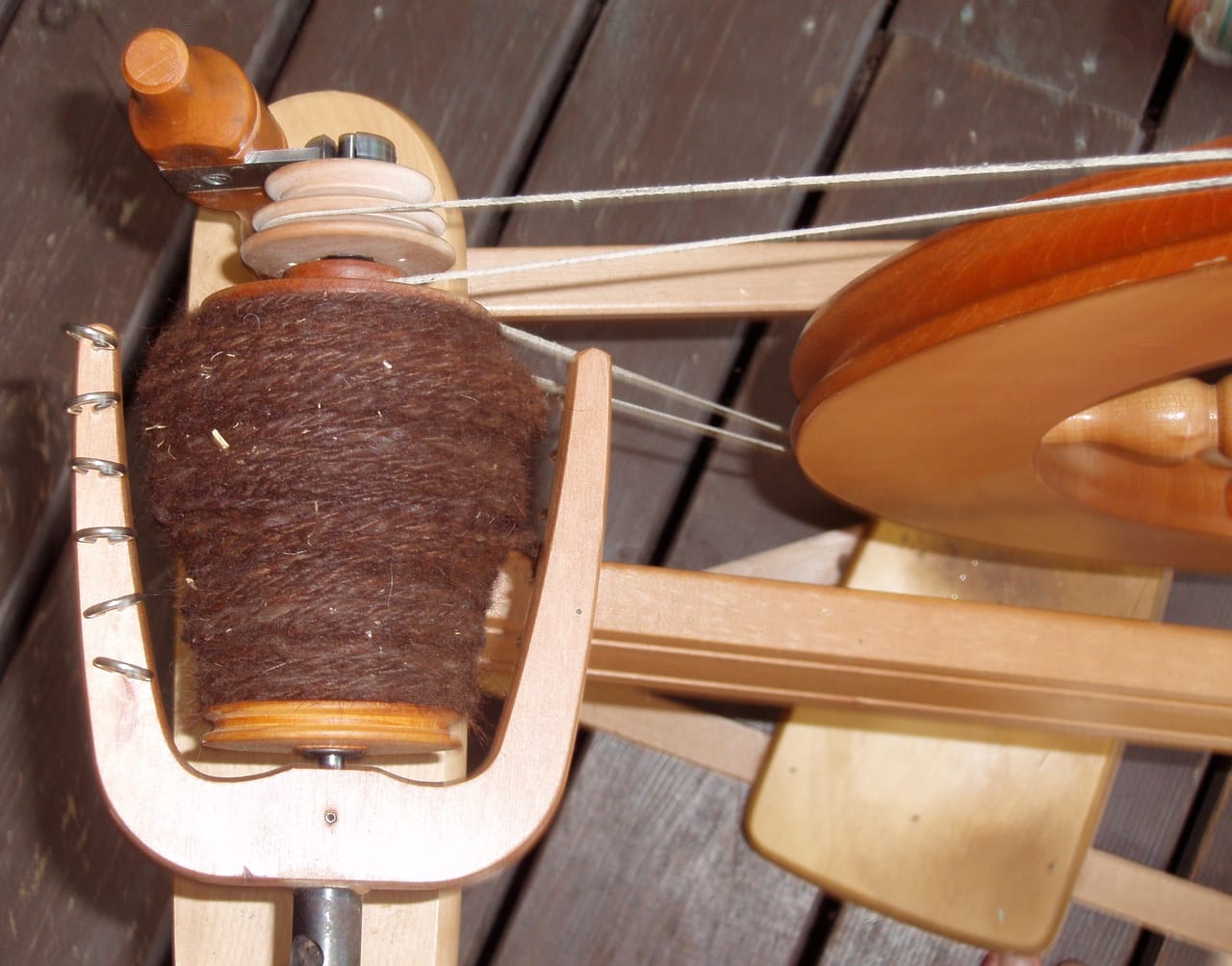
A spinning wheel drive system uses a band looped from the drive wheel to power the flyer, the bobbin, or both, and a brake or whorl differential controls how fast yarn winds on. The three configurations are scotch tension, Irish tension, and double drive. The drive system is the most confusing part for new buyers because the same wheel often supports multiple configurations, and the terminology (scotch, Irish, double) is historical and not self-explanatory. Here is what each one actually does.
Single drive: scotch tension
Scotch tension (also called flyer-led) drives only the flyer with the drive band. The bobbin has a separate spring-loaded brake band resting against its whorl. The brake band does not power the bobbin; it resists the bobbin’s rotation. When the flyer rotates and twist builds in the drafting zone, the yarn’s tension increases until it overcomes the bobbin brake, at which point yarn pulls forward and winds on.
Turning the scotch tension knob tighter increases the spring pressure on the bobbin brake, which means yarn must be under more tension before it winds on. This produces more twist per inch. Looser means yarn winds on more readily with less twist.
Who it suits: beginners and all-purpose spinners. Scotch tension forgives slight inconsistency in drafting; yarn does not wind on faster than the spinner drafts. The Ashford Traditional, Ashford Kiwi 3, Ashford Traveller, and most Schacht single-drive wheels use scotch tension as their default configuration.
Single drive: Irish tension (bobbin lead)
Irish tension (also called bobbin lead or bobbin-driven) reverses the roles. The drive band powers the bobbin directly through its whorl. The flyer has the brake band. Because the bobbin is being actively driven while the flyer is braked, the bobbin tries to rotate faster than the flyer, which creates a winding-on pull on the yarn.
This configuration takes yarn on fast and is ideal for thick, textured, or art yarn that benefits from a strong forward pull. It is also used for corespinning. Because the pull-on is aggressive, Irish tension is harder to manage for fine, tightly twisted singles.
Who it suits: art yarn spinners, chunky yarn, novelty plied construction. Available as a configuration option on many Ashford and Schacht wheels; not all wheels support it.
Double drive
Double drive uses a single long drive band looped in a figure-eight (or crossed) pattern that engages both the flyer whorl and the bobbin whorl simultaneously, driving both. Because the two whorls are different sizes, they rotate at different speeds even though they are connected by the same band. The flyer whorl is larger; the bobbin whorl is smaller. The bobbin rotates faster. This speed differential is what advances yarn from flyer onto bobbin.
The ratio between the two whorl sizes controls the take-up: smaller bobbin whorl relative to flyer whorl means more aggressive take-up. Swapping whorls changes this ratio. Many double-drive wheels come with interchangeable whorl sets for this reason.
Who it suits: experienced spinners who want precise control, long-draw spinning, and high-twist worsted or woolen production. Wheels designed specifically for double drive include the Schacht Matchless; many Ashford Traveller and Reeves wheels support it as a configuration change.
Drive system comparison
| System | What the drive band powers | How take-up is controlled | Best for |
|---|---|---|---|
| Scotch tension (flyer-led) | Flyer whorl only | Brake band spring tension on bobbin | Beginners, all-purpose, consistent fine yarn |
| Irish tension (bobbin lead) | Bobbin whorl only | Brake band spring tension on flyer | Art yarn, thick singles, quick take-up |
| Double drive | Both flyer and bobbin whorls | Whorl size differential | Production spinning, precise twist control |
What is a whorl and how does it set the drive ratio?
A whorl is the small pulley the drive band wraps around, and its size relative to the drive wheel sets the drive ratio, which is how many times the flyer spins per turn of the drive wheel. A smaller whorl gives a higher ratio and more twist. The drive ratio is the relationship between how far the drive wheel travels per revolution and how far the flyer whorl travels per revolution. Since both are circles, it comes down to circumference, which is directly proportional to diameter.
Drive ratio = drive wheel diameter ÷ whorl diameter
A drive wheel 24 inches in diameter with a flyer whorl 1.5 inches in diameter gives a ratio of 16:1: the flyer makes 16 full rotations for each single revolution of the drive wheel. In practice, one treadle stroke moves the drive wheel one half turn (180 degrees), so the flyer makes 8 rotations per treadle.
| Drive Wheel | Whorl | Ratio | Use |
|---|---|---|---|
| 24 in | 3 in | ~8:1 | Bulky yarn, roving, low twist |
| 24 in | 2 in | ~12:1 | DK/worsted weight |
| 24 in | 1.5 in | ~16:1 | Sport/fingering |
| 24 in | 1 in | ~24:1 | Laceweight, fine singles |
Most wheels ship with a stepped whorl or a set of interchangeable whorls covering ratios from about 6:1 to 18:1. A stepped whorl has several grooves of different diameters cut into the same piece, so you change ratio just by moving the drive band to a different groove instead of swapping the whole whorl. The EEW 6 e-spinner replaces the mechanical ratio system with an electronic speed dial (no whorls to swap), which is one reason it suits fine yarn production.
What is the difference between Saxony and castle wheels?
A Saxony wheel spreads the drive wheel and flyer assembly along a long horizontal bench, while a castle wheel stacks the flyer assembly above or beside the drive wheel on a compact vertical frame. The choice between them is mostly about footprint and aesthetics.
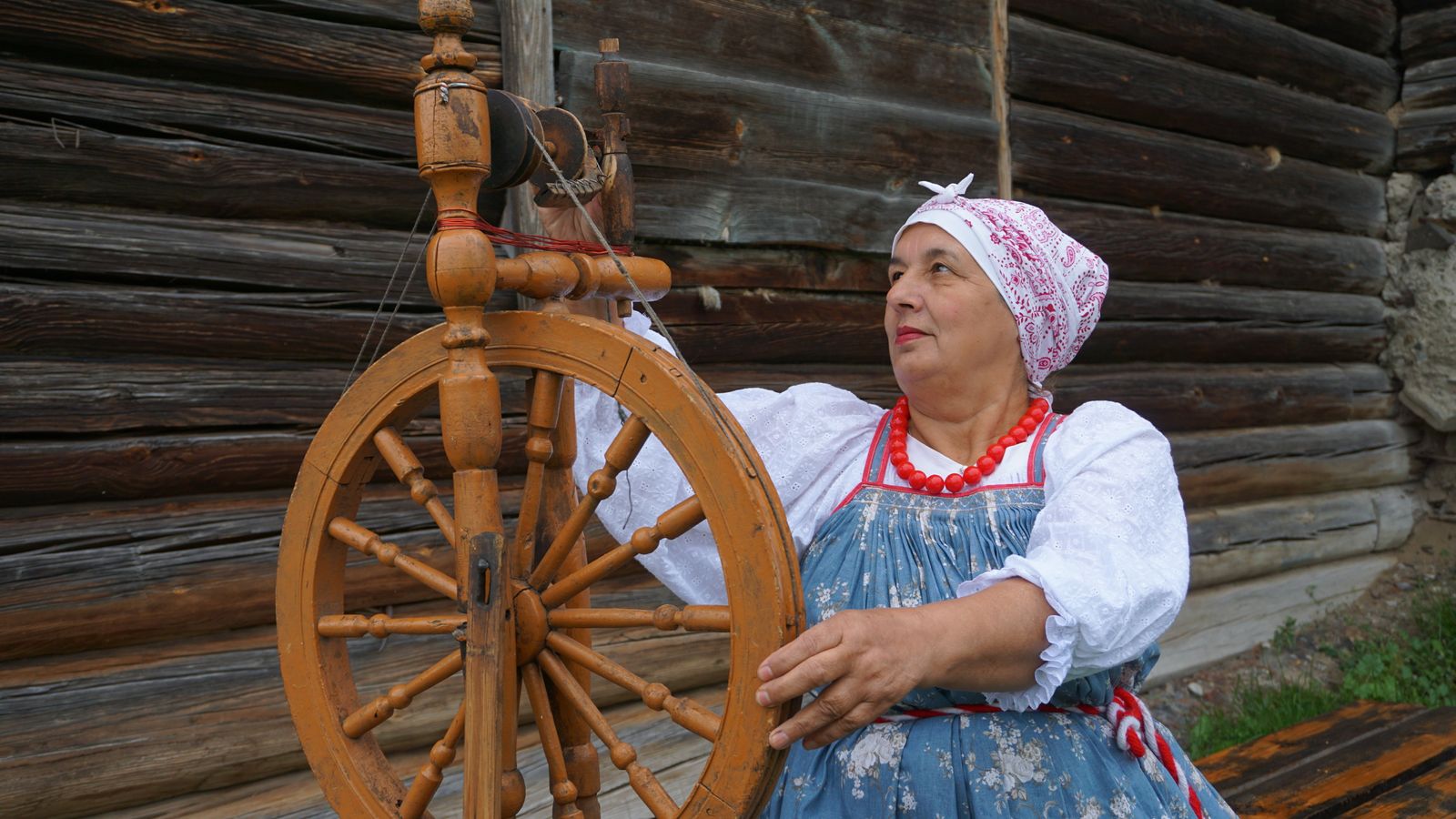
Saxony wheel: horizontal frame, long body, drive wheel at one end and flyer assembly at the other. This is the style in historical paintings and most Western folk art. It looks like a spinning wheel. Saxony wheels need 3 to 4 feet of floor length. Ashford Traditional, most antique wheels, and some production wheels (Ashford Elizabeth, Schacht Reeves) use this form.
Castle wheel (upright or vertical): compact, with the flyer assembly mounted on a post above or beside the drive wheel. Much smaller footprint. Some castle wheels are under 24 inches in any horizontal dimension. This is the dominant form in modern production wheels. Ashford Kiwi 3, Ashford Traveller, Schacht Ladybug, Schacht Matchless are all castle wheels.
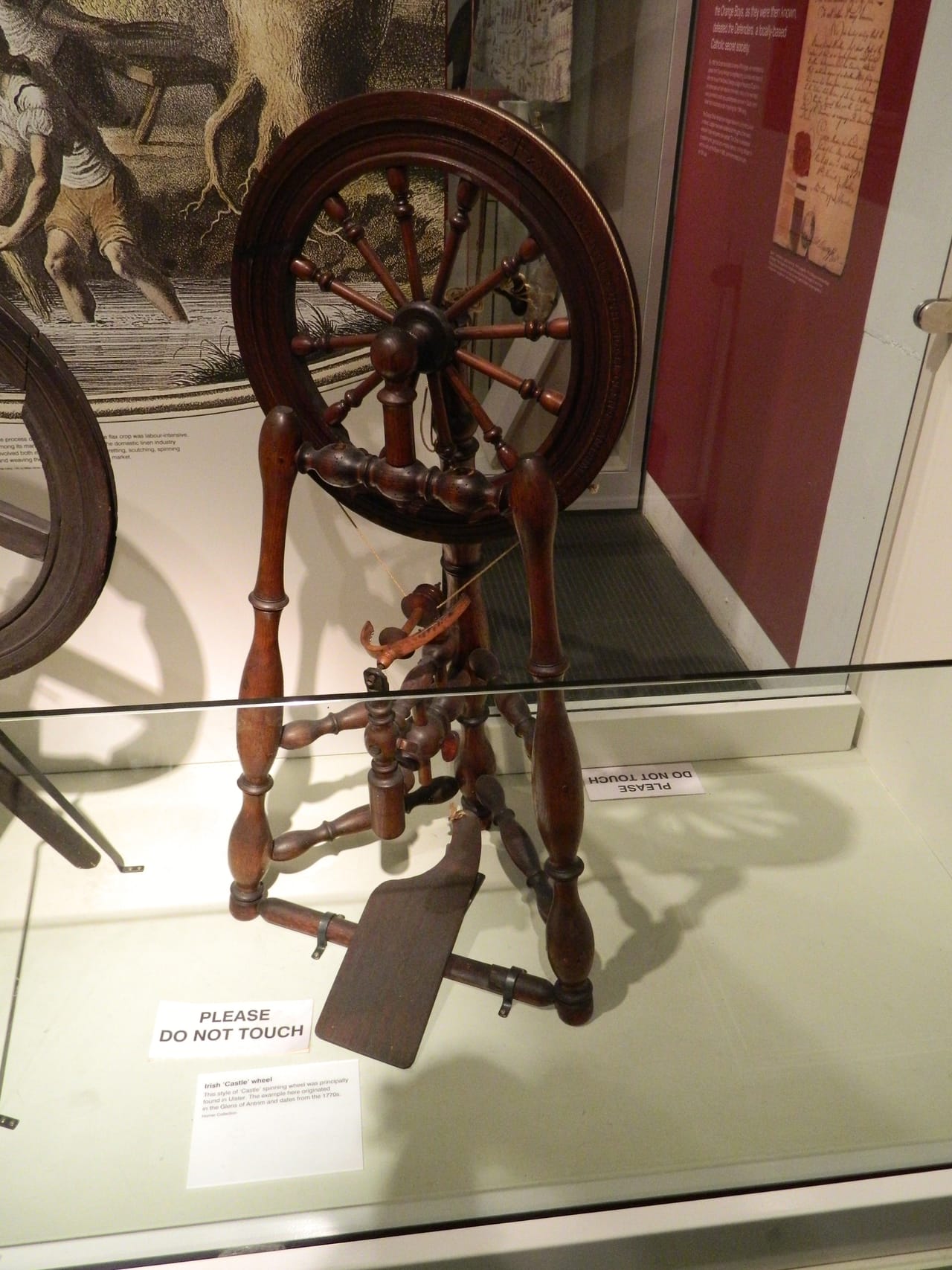
Norwegian / Scandinavian wheel: a third style, less common in North America, where the flyer assembly tilts at an angle rather than sitting perfectly horizontal. The Lendrum folding wheel is a modern example of this design. Functionally identical to a castle wheel.
Quick parts reference
| Part | Location | Function |
|---|---|---|
| Drive wheel | Large outer wheel | Provides momentum; transfers force to flyer via drive band |
| Treadle | Foot platform | Converts foot pressure to wheel rotation via footman |
| Footman | Connecting rod | Links treadle to drive axle crank |
| Mother-of-all | Horizontal bar above wheel | Supports the maidens and flyer assembly; adjusts drive band tension |
| Maidens | Two vertical posts | Hold flyer shaft on bearings |
| Drive band | Cord loop | Transmits rotation from drive wheel to whorl(s) |
| Flyer | U-shaped rotating arm | Inserts twist into drafting zone via rotation |
| Orifice | Hollow tube at flyer tip | Entry point for fiber into flyer-bobbin assembly |
| Flyer hooks | Notched hooks on flyer arms | Guide yarn from orifice to bobbin |
| Bobbin | Spool inside flyer | Stores finished yarn |
| Flyer whorl | Pulley at flyer base | Drive band wraps here to power the flyer |
| Bobbin whorl | Pulley at bobbin base | Drive band or brake band engages here |
| Scotch tension spring | Spring-loaded brake arm | Resists bobbin in single-drive scotch tension |
| Brake band | Cord on bobbin rim | Friction brake; part of scotch tension and Irish tension systems |
| Distaff | Vertical post for fiber (optional) | Holds a prepared fiber supply near the orifice; common on Saxony wheels |
How it works end to end
- The spinner presses the treadle, which rotates the drive wheel via the footman.
- The drive wheel rotates the flyer via the drive band and flyer whorl.
- The flyer rotates around the stationary (or slower) bobbin, inserting twist into the yarn.
- As the spinner drafts fiber forward, twist travels up into the draft zone.
- When enough twist builds, yarn tension overcomes the bobbin brake or the bobbin-to-flyer speed differential winds yarn forward.
- Yarn advances through the orifice, along the flyer arm, catches on a hook, and wraps onto the bobbin.
- The spinner moves the yarn to the next hook as the bobbin fills to distribute yarn evenly.
The same mechanical loop repeats thousands of times in a single spinning session. Adjusting tension is adjusting step 5: how much build-up before yarn advances. Adjusting the whorl changes step 3: how fast the flyer rotates relative to the treadle.
This is the whole machine. Once you can name what controls each step, reading a wheel’s spec sheet (orifice size, whorl ratios, drive system options, treadle configuration) becomes a functional checklist rather than marketing copy.