Best Floor Looms: Picks for Every Budget and Studio Size
The Baby Wolf wins on portability; the Louet David wins on value. Floor loom picks by budget, shaft count, and studio size, with a TCO table per model.
The best floor loom for most weavers moving up from a rigid heddle is the Schacht Baby Wolf: a 4-shaft loom that weaves 26 inches wide, folds to 12 inches for storage, and costs around $1,500 new. The Louet David is the value alternative at $100 to $300 less with a European treadle feel.
The Baby Wolf also has the most comprehensive owner community of any mid-range floor loom in the US, and used examples run $400 to $700. These two looms have been the standard mid-range choices for thirty years because they are the right tools for what most weavers want to make.
What makes a floor loom worth buying?
Floor looms solve a problem that rigid heddle looms cannot: pattern complexity. A rigid heddle makes plain weave, and with extra tools, some simple float patterns. A floor loom makes twills, huck lace, waffle weave, overshot, crackle, summer and winter, and anything else in a 4-shaft pattern book, which is most of the Western weaving tradition. If you want to weave textured cloth, structured lace, or anything other than plain weave scarves and towels, a floor loom is what you need.
The trade is space, cost, and setup time. A floor loom takes up a full corner of a room. A new mid-range loom costs $1,400 to $1,900. Threading 4 shafts takes an afternoon. For weavers who know they want that complexity, the trade is worth it the first time they finish a twill towel or a lace shawl that could not have come off a rigid heddle.
How wide, and how much floor space, do you actually need?
Width is the first decision, before brand or price. For scarves and most apparel yardage, 20 to 24 inches is plenty. Kitchen towels and standard cloth want 24 to 26 inches, the practical minimum that keeps you from piecing seams into a finished project. Blankets and wide fabric woven in a single pass need 45 to 60 inches or more, a different class of loom entirely. Most weavers land in the 24 to 32 inch range and never look back: the Baby Wolf and the Louet David III both weave 26 inches, which covers nearly everything on that list.
The floor itself asks for more than the loom’s footprint. A Schacht Baby Wolf set up to weave occupies roughly 32 inches wide by 48 inches deep, plus another 24 to 30 inches behind the bench so you can actually sit and treadle: call it 5 by 6 feet of dedicated floor, not counting anything stored nearby. The Wolf Pup is smaller, and the Louet David III’s shallower frame (see the comparison table below) gives back a chunk of that depth.
The comparison table
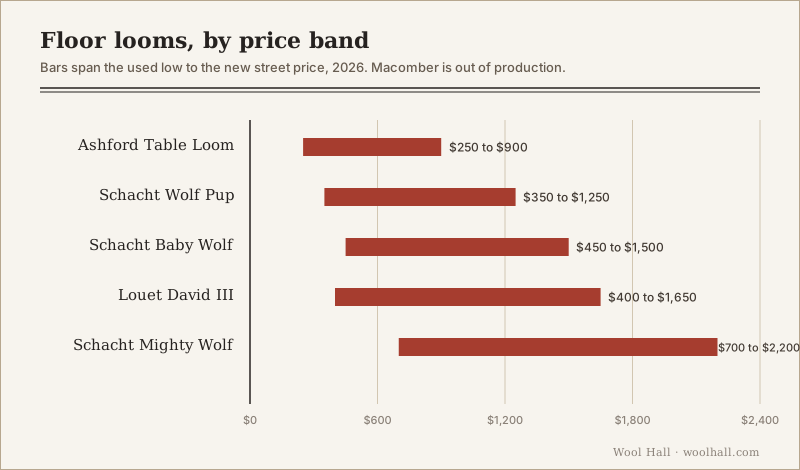
All prices verified June 2026 at manufacturer or major retailer sites. Used prices from Ravelry and guild sale averages.
| Loom | Type | Weaving width | Shafts | New price | Used (good cond.) | Folds |
|---|---|---|---|---|---|---|
| Schacht Wolf Pup | Jack (floor) | 20” | 4 (upgradeable to 8) | ~$1,250 | $350–$600 | Yes |
| Schacht Baby Wolf | Jack (floor) | 26” | 4 (upgradeable to 8) | ~$1,500 | $450–$750 | Yes |
| Louet David III | Jack (floor) | 26” | 4 (upgradeable to 8) | ~$1,650 | $400–$700 | No |
| Ashford Table Loom | Table (with stand) | 16” or 24” | 4 or 8 | $700–$900 | $250–$450 | Partially |
| Schacht Mighty Wolf | Jack (floor) | 36” | 4 (upgradeable to 8) | ~$2,200 | $700–$1,100 | No |
| Macomber (vintage) | Jack (floor) | varies | 4–16 | Out of production | $400–$900 | No |
The picks by buyer
Best for most weavers: Schacht Baby Wolf. The Baby Wolf is 26 inches wide, 4-shaft with an 8-shaft upgrade path, and it folds to move through any standard doorway. It covers nearly the full yarn spectrum too, fine laceweight at 30-plus ends per inch up through chunky wool at 4 EPI, without swapping looms. The construction is Colorado maple with steel tie-up cords; it runs quietly and will outlast the weaver who buys it. The owner community (Ravelry’s Baby Wolf group alone has thousands of members) means that every pattern question and technique problem has been answered by someone who owns the same loom. If you buy one floor loom and keep it for life, this is the loom. See the full Schacht Baby Wolf review for specs, shaft options, and what owners report after years of use.
Best value: Louet David III. The Louet David costs $100 to $300 less than the Baby Wolf new and produces cloth of identical quality. The differences that justify the price gap: the Baby Wolf folds and the David does not; the Baby Wolf has a slightly wider weaving community; the David has the European back-hinged treadle that many weavers find smoother and more ergonomic. On the used market, the two are priced within $50 to $100 of each other. For the full comparison, the Baby Wolf vs Louet David article covers the ergonomic differences in detail. The full Louet David review covers specs.
Best narrow (first floor loom with upgrade path): Schacht Wolf Pup. The Wolf Pup weaves 20 inches wide instead of the Baby Wolf’s 26. That sounds like a compromise, but for weavers who are not sure they need 26 inches of width or who have limited studio space, the Wolf Pup is the right tool. It folds, has the same shaft upgrade path to 8, and costs $200 to $300 less than the Baby Wolf. The Baby Wolf vs Wolf Pup comparison covers who needs each width.
Best for apartment or minimal space: Ashford Table Loom 4-shaft with stand. The Ashford Table Loom is a genuine 4-shaft loom in a compact package. On its stand it occupies roughly the same footprint as a sewing machine. It does not have treadles; you change shafts by hand lever. This makes it slower for production weaving but completely viable for sampling and for weavers who want 4-shaft capability without a room-sized commitment. At $700 to $900 new with the stand, it is also the lowest-cost entry into 4-shaft weaving.
A folding jack loom like the Baby Wolf or Wolf Pup can work in a small apartment too, weaving in about 5 by 6 feet and folding down to a 12-inch footprint against a wall between projects. The real constraint usually isn’t the loom itself: warping needs 6 to 8 feet of clearance in one direction (a wall-mounted warping board solves this), and the beater makes a percussive thump on every pick that carries through shared walls in ways a downstairs neighbor will notice. If that’s a dealbreaker, the table loom above sidesteps both problems. With your own unit and a dedicated room, a folding floor loom works fine.
Best wide: Schacht Mighty Wolf. The Mighty Wolf weaves 36 inches wide, which opens blanket panels and apparel fabric that would require two or three passes on a Baby Wolf. It costs significantly more new ($2,200+) and does not fold. If width is the constraint and you have the room, the Mighty Wolf is the right answer. Most weavers who start on a Baby Wolf and eventually need more width buy a Mighty Wolf rather than selling the Baby Wolf, proof enough of how long these looms last.
Is 4 shafts enough, or do you need 8?
Four shafts are enough for most weavers. Every loom in this guide starts at 4 shafts and can upgrade to 8, which is the right default.
Four-shaft weaving is not a limitation for most weavers. The standard 4-shaft structure library covers plain weave, all twill families, huck lace, M’s and O’s, waffle weave, overshot, honeycomb, crackle, rosepath, and dozens of other structures documented in Ashenhurst and Worst’s classic pattern books. Weavers work within 4 shafts for years before running into the boundaries.
Eight shafts allow networked drafts, more complex twill progressions, and some lace and deflected structures that are difficult or impossible on 4 shafts. If you know you want to weave networked twills (which produce painterly diagonal gradients in cloth), 8 shafts are worth the upgrade cost. Most weavers do not know this yet when buying their first floor loom.
The upgrade path on both the Baby Wolf and the David means you do not have to decide today. Buy 4 shafts, weave for a year or two, and add 4 more when you hit 4-shaft’s limits.
What is the difference between a jack and counterbalance loom?
A jack loom lifts each shaft independently; a counterbalance loom moves shafts in opposing pairs. Most modern American and Canadian floor looms, including every model in this guide, are jack looms: each shaft rises on its own when its treadle is pressed, and all other shafts stay neutral at rest. This makes uneven tie-ups easy and is forgiving of slightly uneven threading.
Counterbalance looms move shafts in opposing pairs: when shaft 1 rises, shaft 2 falls. This produces a cleaner shed for balanced threadings and is why weavers who do a lot of plain weave or traditional overshot sometimes prefer them. Most counterbalance looms available today are vintage Scandinavian looms, reproduction models from European makers, or the Gilmore family. They require a different threading and tie-up approach than jack looms.
If you are new to floor looms, start with a jack loom. The flexibility is useful while you are learning what structures you want to weave.
What does a floor loom really cost beyond the loom?
A floor loom’s sticker price is not the total cost of ownership. Plan for $300 to $700 in accessories on top of the loom. Add to the new loom price:
- Bench: $150 to $400 new. Many looms do not include one. A dedicated weaving bench with adjustable height is important for correct posture and treadling.
- Boat shuttles: $15 to $40 each. You will want 3 to 6 for multi-color work.
- Temple: $30 to $80. Keeps the cloth at full warp width as you weave. Worth buying early.
- Lease sticks: $20 to $40 per pair. Some looms include them.
- Warping board or mill: $60 to $200. A separate warping board is faster than using the loom’s back beam for all warps.
- Extra reeds: $30 to $100 each. Your loom ships with one reed; plan to buy 2 to 3 more over time.
Total startup cost beyond the loom: $300 to $700 for a properly equipped first floor-loom setup. For full dimensions on where to put the loom in a room, the space planning guide has floor plans for every loom size.
Should you buy a used floor loom?
Yes, for most first-time buyers a used loom is the smart entry. Both the Baby Wolf and the Louet David have been in continuous production for decades. The used market has hundreds of them in circulation at any given time, typically priced at 40 to 60 percent of new retail. A 2005 Baby Wolf in good condition weaves identically to a 2025 model; Schacht supports both with the same replacement parts.
For a weaver who is not yet certain about floor-loom weaving, buying used is a lower-risk entry: if you discover you prefer rigid heddle weaving or spinning, you can sell a used floor loom at close to what you paid. The used loom buying guide covers the inspection checklist and what price to accept.