Rigid Heddle vs Floor Loom: Which One Should You Buy?
What a rigid heddle can weave vs what a floor loom adds: plain weave, twill, lace, prices from $225 to $2,386+, and when to upgrade. Verified June 2026.

A rigid heddle loom and a 4-shaft floor loom both make cloth, but they access fundamentally different ranges of structure. A rigid heddle at $225–$315 weaves plain weave, pickup patterns, and color variations. A floor loom at $1,963–$2,386+ adds twill, lace, overshot, and the full range of 4-shaft weave structures. Prices verified June 2026 at manufacturer and dealer sites.
| Feature | Rigid Heddle | 4-Shaft Floor Loom |
|---|---|---|
| Price entry | $225 (Cricket 10”) | $1,963 (Wolf Pup LT 18”) |
| Setup | Tabletop, no floor space | Floor-standing, permanent |
| Shed mechanism | 1 reed, 2 sheds | 4 shafts, 6+ shed combos |
| Plain weave | ✓ | ✓ |
| Pickup stick patterns | ✓ | ✓ |
| 2/2 twill | ✗ | ✓ |
| Herringbone | ✗ | ✓ |
| 4-shaft huck lace | ✗ | ✓ |
| Honeycomb | ✗ | ✓ |
| Waffle weave | ✗ | ✓ |
| 4-shaft overshot | ✗ | ✓ |
| Max width (typical) | 48” (Ashford RHL) | 26”+ |
| Weight | 3–8 lbs | 40–70+ lbs |
What can a rigid heddle loom weave?
A rigid heddle weaves plain weave, warp-faced and weft-faced patterns, pickup-stick floats, and (with a second heddle) simple supplemental-warp textures. It cannot open more than two sheds automatically, so it stops short of shaft-controlled structures. The rigid heddle’s mechanism is a single reed with alternating slots and holes. When the reed moves up, the threads in the holes rise and the threads in the slots stay down: one shed. When the reed moves down, the positions reverse: the second shed. Every pass of the shuttle alternates between these two positions.
That two-shed mechanism produces plain weave at full speed: over-under-over-under, uniform, efficient. It also produces:
- Warp-faced patterns: sett the warp so tightly that only warp shows on the surface. Weave rugs, belts, and bands this way.
- Weft-faced patterns: beat loosely so only weft shows. Weft stripes, color gradients.
- Pick-up stick patterns: with a pickup stick in the open shed, you can manually select specific warp ends to create floats: supplemental warp floats, supplemental weft floats, simple color designs, even twill-like diagonal effects that mimic true twill’s look. True twill itself stays out of reach this way: a pickup stick produces those floats one row at a time, by hand, not a repeating shed sequence at shuttle speed. This is slow and requires manual intervention on every patterned row, but it produces real variety.
- Two-heddle structures (on looms with second-heddle hardware): two heddles together add supplemental-warp textures, simple twill-like overlaps, and clasped-weft color play. Not equivalent to 4-shaft weaving, but a meaningful extension.
What the rigid heddle cannot do: open more than two sheds automatically, repeat a complex pattern at production pace, or produce any structure requiring independent control of four or more shaft groups.
What can a 4-shaft floor loom do that a rigid heddle cannot?
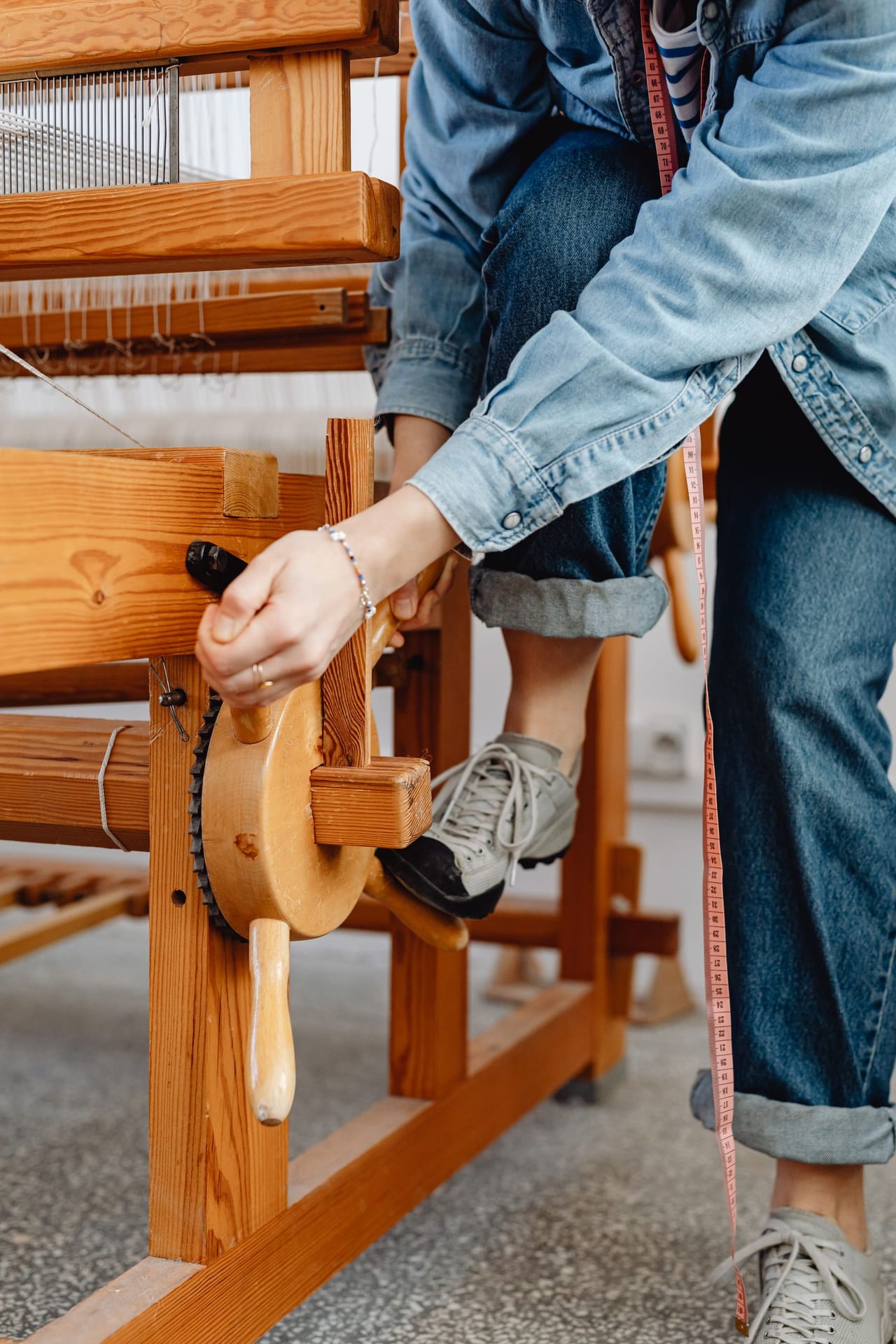
A 4-shaft floor loom weaves twill, herringbone, huck lace, honeycomb, waffle weave, M’s and O’s, overshot, and doubleweave: structures that need four independently controlled shafts. A rigid heddle cannot reach any of them at speed. A 4-shaft floor loom has four shaft groups, each independently raised or lowered by a treadle tied to that shaft. Six treadles are standard, and you tie each treadle to one or more shafts in a pattern matching the weave structure you want to weave.
This means you can program and repeat complex shed sequences without touching any thread manually. Threading 2-2 twill (threads in a sequence 1-2-3-4, 1-2-3-4…) and tying treadles to open shafts 1+2, 2+3, 3+4, 4+1 gives you a continuous diagonal twill that repeats every four picks, at full shuttle speed, not manually picked.
Structures only accessible on a floor loom:
- 2/2 twill: two over, two under, repeating on a diagonal. Denim, tweed, and most suiting is woven in 2/2 twill. The diagonal interlacement is softer and more flexible than plain weave at the same sett.
- Herringbone: twill that reverses direction at regular intervals, producing a V-shaped or fishbone pattern. Standard in wool suiting and classic scarves.
- 4-shaft huck lace: a textured lace structure using floats on both warp and weft faces. Produces the honeycombed, open texture of traditional huck toweling.
- Honeycomb: the textured waffle-like structure of honeycomb towels and blankets. Requires four shafts to produce the cell walls correctly.
- Waffle weave: similar to honeycomb, with deeper three-dimensional cells. Washcloths, bath towels, spa items.
- M’s and O’s: a classic overshot-adjacent structure producing a textured surface with vertical and horizontal float groups.
- 4-shaft overshot: the American colonial block weave with supplemental pattern floats. Traditional coverlets, star patterns, table runners.
- 4-shaft doubleweave: two separate cloth layers woven simultaneously on the same loom. Double-wide blankets, pocket bags, color-and-weave doubleweave.
None of this is one-way, though. A floor loom weaves everything a rigid heddle weaves, plain weave, pickup-style float patterns, every warp-faced and weft-faced structure, on top of the shaft-controlled structures above. Nothing in rigid heddle weaving is exclusive to the rigid heddle. What the rigid heddle actually offers is simplicity, price, and portability, not a set of structures the floor loom can’t touch.
How much does a floor loom cost versus a rigid heddle?
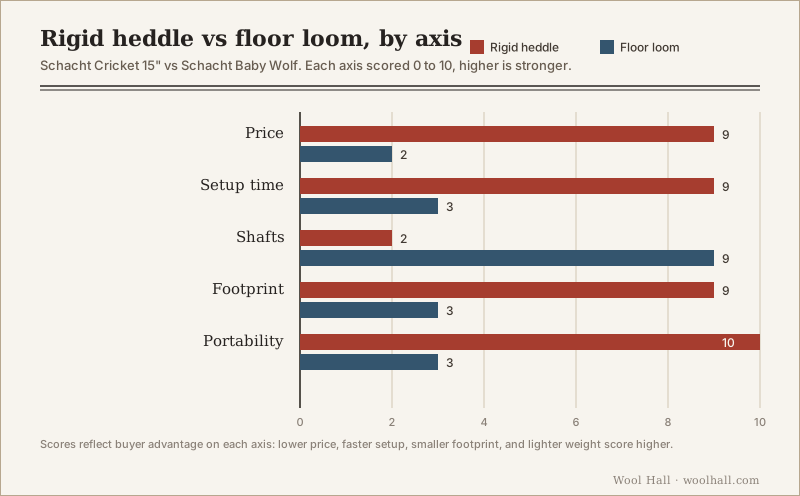
A rigid heddle runs $225 to $315; a 4-shaft floor loom starts at $1,963 (Wolf Pup LT) or $2,386 (Baby Wolf). The Cricket Quartet bridges the gap at $743 total. The gap between a rigid heddle and a floor loom is real and large.
| Loom type | Price | Width | Shaft count |
|---|---|---|---|
| Schacht Cricket 10” | $229 | 10” | 1 (rigid heddle) |
| Schacht Cricket 15” | $246 | 15” | 1 (rigid heddle) |
| Ashford Rigid Heddle Loom | $315 | 16”–48” | 1 (rigid heddle) |
| Cricket + Cricket Quartet | $743 | 15” | 4 (true shafts) |
| Schacht Wolf Pup LT | $1,963 | 18” | 4 |
| Schacht Baby Wolf | from $2,386 | 26” | 4 (upgradeable to 8) |
The Cricket Quartet is the bridge. At $743 total, the 15-inch Cricket with the Quartet upgrade is the lowest-cost path to true 4-shaft weaving. It is still a table-mounted 15-inch loom (not a floor loom) but it weaves twill, huck lace, and all other 4-shaft structures. For a weaver who wants 4-shaft structures without committing to floor-loom space and price, the Quartet is the answer that falls in between.
The trade-off: the Cricket Quartet is 15 inches wide. A floor loom gives you 26 inches (Baby Wolf) or 18 inches (Wolf Pup LT). If you want to weave bath towels, blanket panels, or wide shawls, 15 inches is not enough regardless of shaft count.
How much space does each loom need?
A rigid heddle is genuinely space-neutral; a floor loom is not. A rigid heddle fits on a kitchen table, a desk, or a lap desk. The Cricket 15-inch is roughly 24 by 18 inches when warped. The Ashford Rigid Heddle Loom at 48 inches is large, but still table-based. You clamp it to the table edge and warp it, and when you’re done, you lean it against a wall. No permanent floor space required.
A floor loom requires floor space and stays up between sessions. The Baby Wolf folds to approximately 48 by 32 inches (roughly a large suitcase on its side) and most weavers set it up and leave it. The Wolf Pup LT folds to 16 inches deep with built-in wheels, which is genuinely compact for a floor loom, but it still lives in your room when you’re not weaving on it.
For apartment or shared-space weavers, a rigid heddle set on a stand, stored against a wall, takes no dedicated space. A floor loom always claims its corner of the room.

Who should buy a rigid heddle?
Buy a rigid heddle if you are new to weaving, working under a $500 budget, short on floor space, or weaving narrow plain-weave projects like scarves and towels. It is the standard starting loom for good reason: the mechanism is four steps you can learn in an afternoon. Load the warp, raise the heddle, pass the shuttle, lower the heddle, pass it back. The learning curve for plain weave runs in hours, not weeks, and most beginners finish a first project, a scarf or a color-blocked towel, in their first sitting at the loom.
A rigid heddle is the right loom if:
- You are new to weaving and do not know yet whether it will become a serious practice
- Your budget is under $500
- You want to weave scarves, kitchen towels, simple table runners, narrow yardage
- You have no floor space for a dedicated loom
- You travel with your loom or weave at guild meetings
- You want to learn plain weave before deciding whether to pursue more complex structures
Start with a rigid heddle first project, a striped scarf or color-blocked towel, and you will know within two or three warps whether weaving is going to stay a hobby, grow into a craft, or need more structure than one heddle can provide.
Who should buy a floor loom?
Buy a floor loom if you already weave on a rigid heddle and specifically want twill, lace, or overshot, have the floor space and a $1,963+ budget, or need cloth wider than 15 inches. It rewards committed weavers, not the merely curious.
A floor loom is the right loom if:
- You already weave on a rigid heddle and specifically want twill, lace, or overshot
- You have made the same plain weave projects for a year and want structure variety
- Your budget is $1,963+
- You have floor space for a dedicated loom
- You want to weave bath towels, blanket panels, or wider cloth than 15 inches can produce
- You are certain enough about weaving to make a $2,000+ commitment
The most common mistake is buying a floor loom too early (before knowing whether weaving will stick) and then reselling it at a loss within a year. The most common mistake in the other direction is staying on a rigid heddle too long, spending two years wanting twill and not getting it, when the Cricket Quartet or a used floor loom would have resolved that in the first month.
When should you upgrade from a rigid heddle to a floor loom?
Upgrade when you concretely want twill, lace, or overshot and have hit the rigid heddle’s two-shed wall in practice, not in theory. The upgrade signal is specific: you want weave structures that require four independently controlled shafts and you have hit that wall concretely. Not “I think I might want twill someday,” but “I have tried pickup stick twill, I understand it produces diagonal floats manually, and I need it to repeat automatically at pace.” For most weavers that moment lands somewhere between six months and a year of steady rigid heddle weaving, once you have made enough plain-weave projects to know the mechanism cold and start noticing what it will not do.
If that moment has arrived:
- Cricket Quartet first if you are on a 15” Cricket and 15 inches is enough width. $497 additional cost, true 4-shaft, no new floor space required.
- Used floor loom if you want 4-shaft with more width and are willing to accept some risk. A used Baby Wolf or equivalent in good condition will cost $800–$1,500 and give you 26 inches and 4 shafts.
- New floor loom if you want warranty, known history, and the option to upgrade to 8 shafts later. The Baby Wolf at $2,386 with the Four-Now-Four-Later upgrade path is the standard recommendation for a weaver moving to floor-loom weaving for the long term.
Neither a rigid heddle nor a floor loom is objectively better. They serve different weavers and different ambitions. A rigid heddle at $246 is not “less than” a floor loom; it is the right tool for the work most beginners actually do. A floor loom is not “more than” a rigid heddle; it is the right tool for the work that shaft-controlled structures require.