Schacht Cricket Loom Review: The First Rigid Heddle
The Schacht Cricket is the rigid heddle loom most weavers should start on. Owner reports, a spec table, width-per-dollar math, and the honest used-market read.
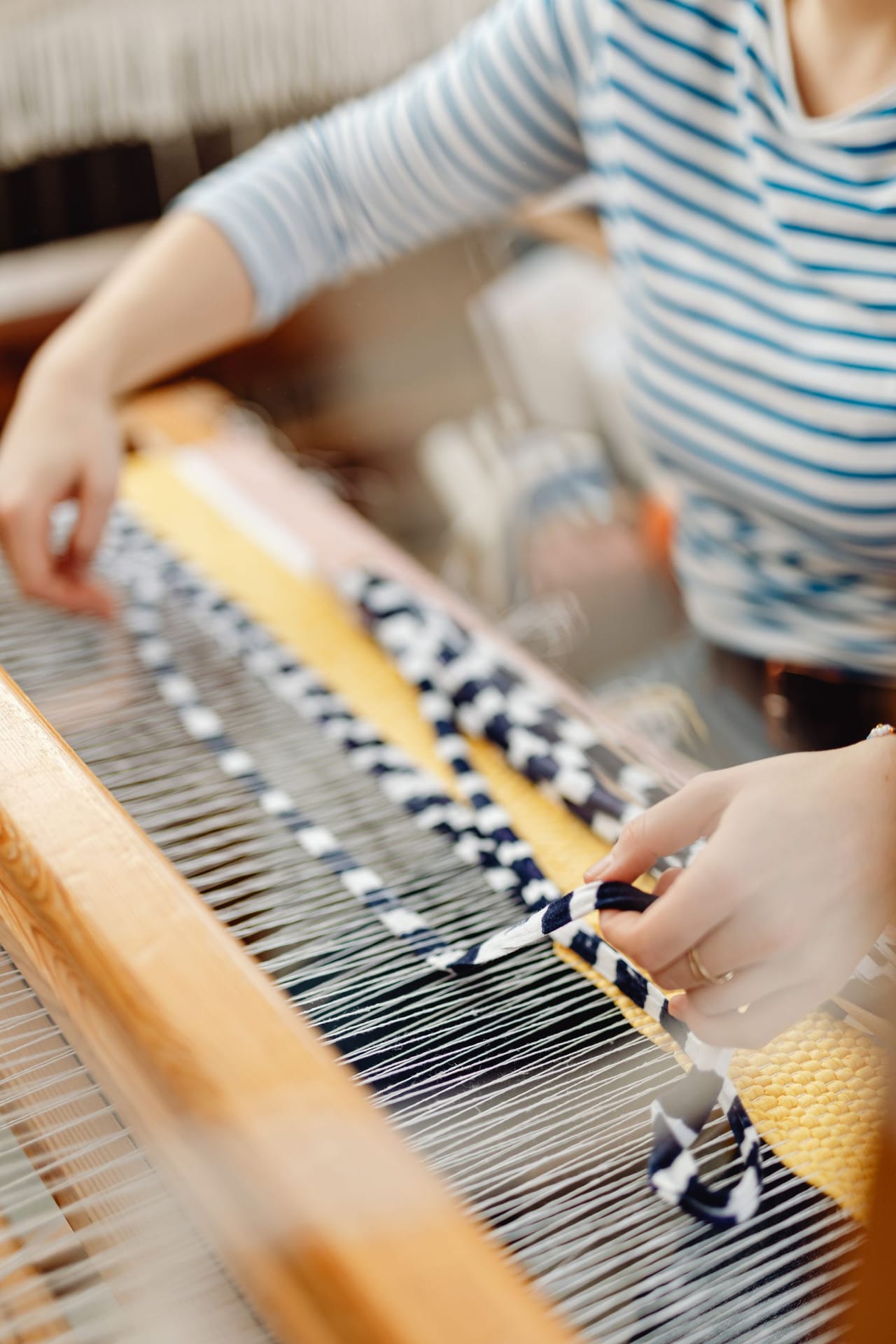
The Schacht Cricket is the rigid heddle loom most new weavers should buy first. It assembles in under an hour, ships ready to warp with an 8-dent reed and two shuttles, and owner reviews run around 4.8 out of 5. The only real decision is width: 10 inch or 15 inch.
Owner reviews across weaving blogs and retailer pages run strongly positive, and the rigid heddle design is the most direct path from “I bought a loom” to “I made a scarf.” Schacht has built the Cricket in Boulder, Colorado, from hard maple and maple plywood since 2009, and the loom has barely changed because it did not need to. A 6-pound table loom that costs about $230 new and weaves cloth your friends assume came from a real studio is a hard thing to improve on. What follows is the spec sheet weighed and judged, what people who actually warped one report, the width-per-dollar math against the Ashford that everyone cross-shops, and an honest read on the used market.
Weighed and Judged
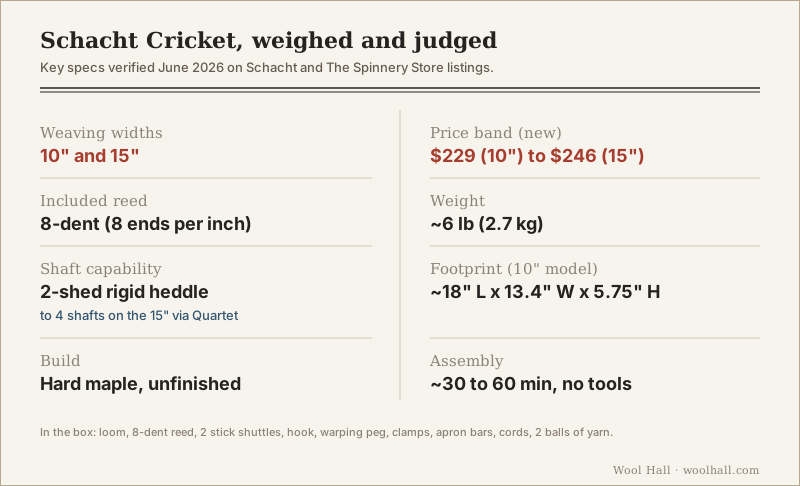
Here is the Cricket measured against the things a buyer actually decides on. Prices and specs verified June 2026 on Schacht’s own pages and on The Spinnery Store’s per-width listing.
| Specification | Schacht Cricket |
|---|---|
| Weaving widths | 10” (25 cm) and 15” (38 cm) |
| Included reed | 8-dent (8 ends per inch); 5, 10, 12, 15-dent sold separately |
| In the box | Loom, 8-dent reed, 2 stick shuttles, threading hook, warping peg + clamp, 2 table clamps, 2 apron bars, 6 apron cords, 2 balls of yarn |
| Material | Hard maple and maple plywood, unfinished |
| Weight | ~6 lb (2.7 kg) |
| Footprint (10” model) | ~18” L x 13.4” W x 5.75” H |
| Shaft capability | 2-shed rigid heddle (plain weave + pick-up); upgradable to 4-shaft on the 15” via Cricket Quartet |
| Price (new) | ~$229 (10”) / ~$246 (15”) |
| Assembly | Required; ~30–60 minutes, no special tools |
The 8-dent reed is the right default. It handles worsted-weight wool and most DK yarns, which is exactly what a first warp tends to be. The unfinished maple is deliberate: Schacht leaves it bare so you can oil it or leave it, and it ages to a warm honey color with handling.
Check current price on the 15” Cricket if you want the width that accepts the 4-shaft upgrade later. As an Amazon Associate, Wool Hall earns from qualifying purchases.
What can you actually weave on a rigid heddle loom?
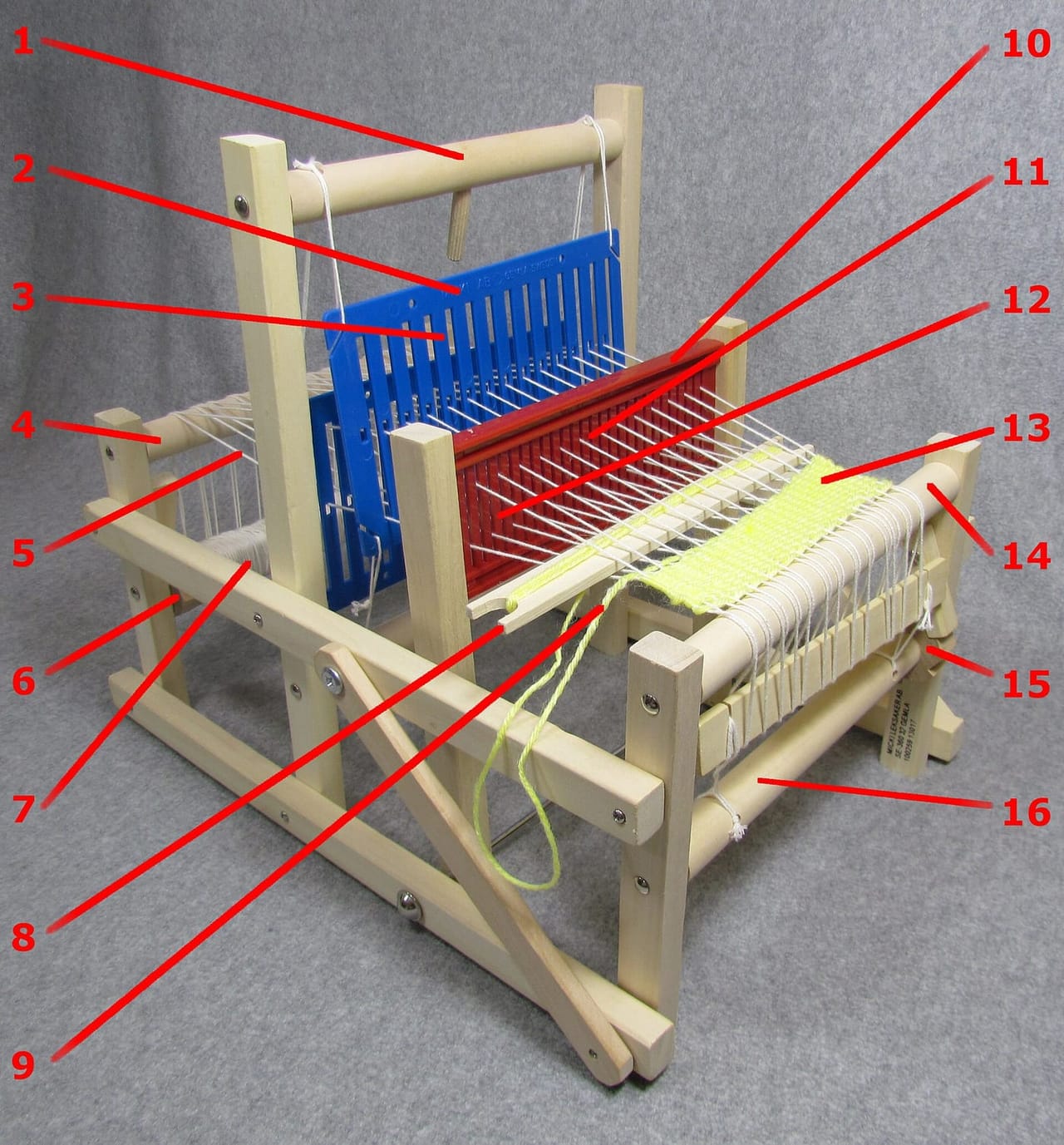
Plain weave is the Cricket’s native language: one shed up, one shed down, weft over and under. That covers more than beginners expect. Scarves, dish towels, placemats, table runners, panels you can seam into a tote or a baby blanket, and plain yardage up to the reed width. The famous handwoven kitchen towel, the thing half of new weavers make first, is plain weave on a rigid heddle loom.
Beyond plain weave, the Cricket does more with a couple of cheap tools. A pick-up stick lets you lift selected warp threads to make float patterns, the textured stripes and geometric motifs you see on rigid-heddle scarves. Add a second heddle (the Cricket accepts one with a variable heddle block) and you can weave double width, or build simple twill-like structures that a single heddle cannot.
What it cannot do, honestly: true multi-shaft twills, complex overshot, and anything that needs four independent shafts lifting in sequence. That is a floor-loom or table-loom job. The one exception is Schacht’s own Cricket Quartet, a $497 add-on that bolts onto a 15” Cricket and turns it into a genuine 4-shaft loom with a 13.5” weaving width and 300 Texsolv heddles. It is not cheap, but it means a 15” Cricket has an upgrade path that the 10” simply does not.
You can also weave tapestry on a Cricket, with caveats. Kelly Casanova and Schacht’s own archive both confirm it: warp it, ignore the heddle for shed changes if you want a weft-faced look, and beat with a fork or tapestry beater because the reed does not pack weft tightly enough. It works for small pieces. It is not what the loom is built for, and a frame loom holds better tension for the job. If wall-hangings are your real goal, start with the tapestry loom guide instead.
| Project | 10” Cricket | 15” Cricket |
|---|---|---|
| Skinny scarf / sampler | Yes | Yes |
| Standard scarf (7–8” wide) | Yes | Yes |
| Kitchen / tea towel | Tight | Yes |
| Table runner | Narrow only | Yes |
| Placemats | No (too narrow) | Yes |
| Cowl / infinity scarf | Yes (seamed) | Yes |
| Blanket / throw | Panels, seamed | Panels, seamed |
| Pick-up float patterns | Yes | Yes |
| True 4-shaft twill | No | Only with Cricket Quartet |
What do owners actually report about the Cricket?
Owners like it, and the few complaints are minor and repeat. Across weaving-blog reviews, shop reviews, and Schacht’s own documentation, the Cricket lands in a narrow, consistent band: high praise for assembly and output, with a couple of small gripes that show up again and again.
The most-praised traits, named across sources. Ease of assembly comes up first and everywhere; the Weaves & Knits review calls it “exceptionally easy to assemble and use, even for those new to weaving” and the WEBS/yarn.com reviewers echo that it is “easy to assemble and works well.” Portability and storage are the second theme, the compact foldable frame slipping onto a shelf. The third is output quality out of proportion to effort, “professional-looking fabrics with minimal effort” in the Weaves & Knits assessment, which rated the loom 4.8 out of 5 and called it “the best compact weaving loom on the market.” The build itself draws repeated praise for being mostly wood: Schacht’s rigid heddles use the same maple for the handles as the rest of the frame, which is the quiet answer to the plastic-parts complaint that dogs cheaper looms.
The gripes are real but small. The single most common is the included starter yarn: more than one reviewer wished Schacht “had provided more yarn for the first project,” which runs out before a full scarf. The warping learning curve is the other recurring note, though it is a rigid-heddle-weaving issue more than a Cricket issue. The Cricket actually warps more easily than some rivals because it has two beams (warp and cloth) and a generous warping setup despite a shallow depth behind the heddle. New weavers still find the first warp fiddly. Everyone does. The second warp takes a third of the time.

The plastic-parts debate deserves a straight answer, because it comes up whenever rigid heddle looms are compared. On the Cricket it is mostly a non-issue: the frame, beams, and handles are maple, and the heddle itself is the standard nylon-and-frame rigid heddle every loom in this class uses. The looms that earn the “too much plastic” complaint are the sub-$80 import kits, not the Cricket.
Should you buy the 10-inch or 15-inch Cricket?
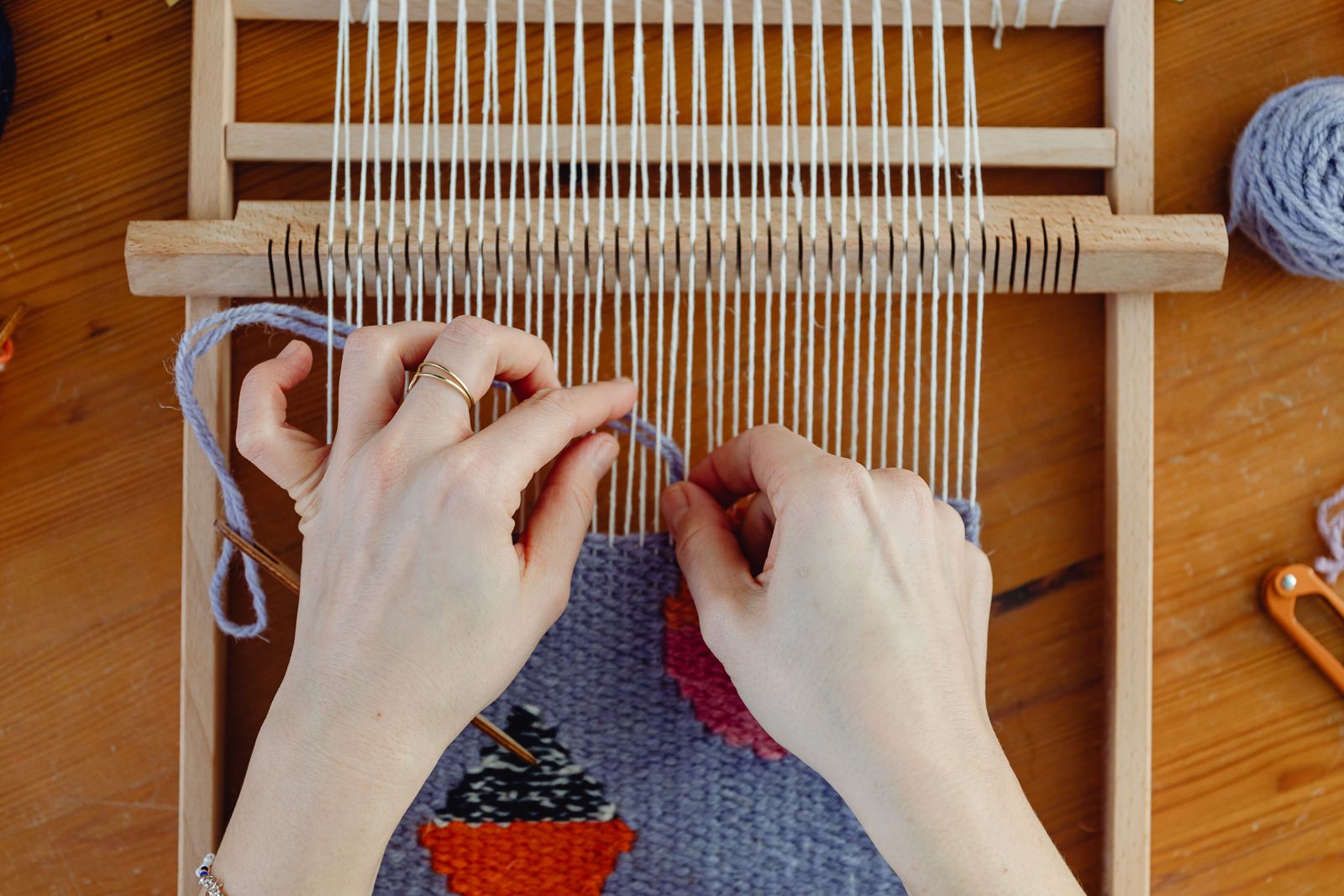
Buy the 15-inch unless storage is genuinely tight. The two Crickets cost about $229 and $246 new, so that $16 difference buys you 5 inches of weaving width, which is the cheapest width upgrade in the entire rigid-heddle category. Spread across the price of the loom, the 15” costs roughly $16.40 per inch of width against the 10” at $22.90 per inch. The wider loom is the better value on raw width-per-dollar, and it is the only one that takes the Cricket Quartet.
It is worth seeing the Cricket against the Ashford lineup it is always cross-shopped with, because the comparison is closer than the Cricket’s reputation suggests. Prices verified June 2026 on Gist Yarn and The Woolery.
| Loom | Weaving width | Price (new) | Cost per inch | Included reed |
|---|---|---|---|---|
| Ashford SampleIt | 10” | ~$225 | $22.50 | 7.5-dent |
| Schacht Cricket | 10” | ~$229 | $22.90 | 8-dent |
| Ashford SampleIt | 16” | ~$255 | $15.94 | 7.5-dent |
| Schacht Cricket | 15” | ~$246 | $16.40 | 8-dent |
| Ashford Rigid Heddle Loom | 16” | ~$315 | $19.69 | 7.5-dent |
| Ashford Rigid Heddle Loom | 24” | ~$315 | $13.13 | 7.5-dent |
Two things fall out of that table. First, at the 10” and mid widths, the Cricket and the Ashford SampleIt are within a few dollars of each other; the choice between them is about feel, ecosystem, and reed preference, not price. Second, if you want serious width cheaply, Ashford’s full Rigid Heddle Loom wins on cost per inch once you get to 24 inches, because Ashford holds a flat price across its wider widths while Schacht caps the Cricket at 15”. The Cricket is not the loom to buy if you already know you want to weave blankets in one piece. It is the loom to buy if you want the best-supported, best-built entry point and the option to grow into shaft weaving later.
For the full head-to-head, see Schacht Cricket vs Ashford rigid heddle. If you want the wider Ashford family decoded, the Ashford rigid heddle review covers SampleIt, Rigid Heddle Loom, and Knitters Loom.
How much do used Schacht Cricket looms sell for?
Used Crickets in good condition cluster around $100 to $180, against roughly $229 to $246 new, though listings are intermittent. This is where Wool Hall normally hands you a table of dated sold prices. For the Cricket, honesty requires a caveat: verifiable sold-listing data is thin. Crickets do not flood the secondhand market the way $2,000 floor looms do, because owners keep them. A Cricket is small, cheap to begin with, and useful for a lifetime, so it rarely gets resold.
That band depends on width and on whether extra reeds or a stand are included. The saving is real but smaller than on big looms: a used floor loom can be 40 to 60 percent off new, while a used Cricket is more like 20 to 40 percent off, and the supply is intermittent. Call it thin data, plainly labeled. If you find a clean used Cricket with the original reed for around $120 to $150, it is a fair buy. Do not wait months hunting for one when a new loom is $230 and ships this week.
A used Cricket is worth checking for one thing specifically: the reed. A warped or cracked rigid heddle is the part most likely to be damaged, and a replacement 8-dent reed runs a meaningful fraction of the secondhand price. Confirm the reed is straight and the apron cords are intact before you buy.
Choose the Ashford instead if…
The Cricket is our default recommendation, not a universal one. Choose differently if:
- You want maximum width on a budget. Ashford’s Rigid Heddle Loom in 24” or 32” beats the Cricket on cost per inch and weaves a blanket in one piece. The Cricket stops at 15”.
- You want the biggest accessory ecosystem. Ashford’s family (SampleIt, Rigid Heddle Loom, Knitters Loom) shares a huge range of reeds, stands, and second-heddle kits. See the Ashford rigid heddle review.
- You want a built-in warping board. The Kromski Harp Forte builds the warping pegs into the loom frame, which some weavers love. The Cricket uses a separate peg and clamp.
- You already know you want 4-shaft weaving soon. A real table loom or the Louet David makes more sense than a Cricket plus a $497 Quartet, unless portability is paramount.
For everyone else, which is most first-time weavers, the 15” Cricket is the loom. It is the best-built entry point in the category, it is supported by more tutorials than any rival, it holds its value, and the only upgrade path that keeps your loom is the one Schacht built for it. Buy the 15”, buy a pick-up stick, and weave a towel by the weekend.
Still deciding between rigid heddle and a real floor loom? Start with rigid heddle vs floor loom, then plan your first warp with the rigid heddle first project walkthrough. When you are ready to shortlist, the best rigid heddle loom roundup ranks the whole field by width and budget.